

8 Jan 1916
Gateshead
died: St Leonards-on-Sea 8 Feb 2004
223
1946 — 1953
3
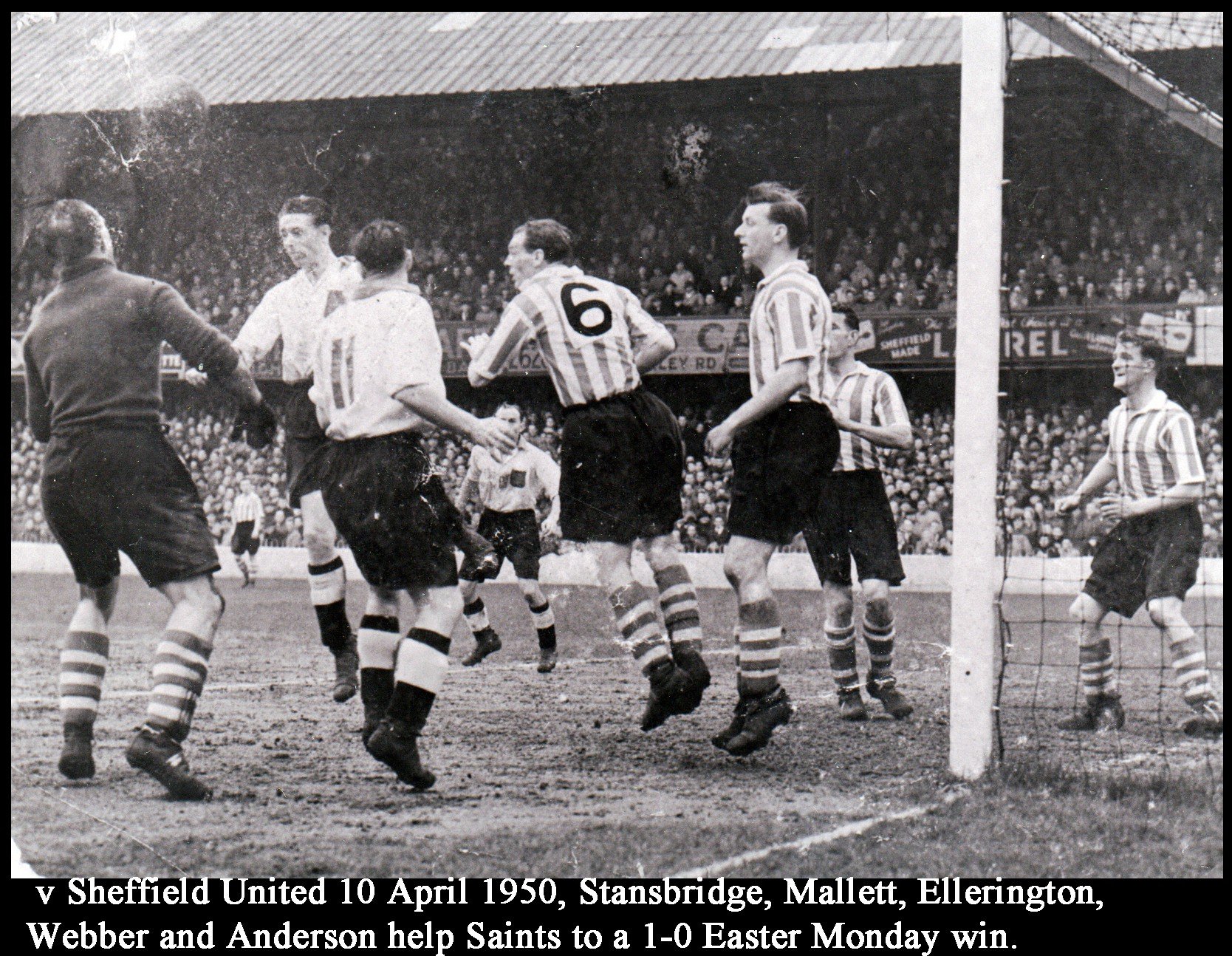
Joe Mallett came down from works-football on the Tyne to London, as a teenager in 1935. In his stay of 11½ years – half of it lost to the War, of course – he had a couple of League games for Charlton and 70 for Queens Park Rangers, before Bill Dodgin, a former Charlton team-mate, brought him to The Dell in February 1947. The 31 year-old inside-right was about to be born again.

Playing “a bit deep” for a No.8 – he was “considered to be a schemer,” he reckoned – he soon swapped that shirt for the No.6 and kept it for another 200-odd games. As a left-half, he needed to combine attacking skills – “I was always a good passer of the ball and could dribble” – with defensive qualities: he “could tackle a little bit, but… couldn’t head a ball.” Continuing with his self-assessment, he attributed his survival as a defender to being “quick and I used to try and read the game. I was very good on interceptions.” Behind him, at left-back, his veteran captain, Bill Rochford, was another renowned “reader” of the game. While that was crucial to Rochford’s command on the field, centre-half Stan Clements claimed that the less articulate skipper depended, off the field, upon Mallett, his lieutenant, who
“was educated, both on and off the pitch, and could talk football.”
This awesome pair effectively groomed two young right-backs – Alf Ramsey and Bill Ellerington– to play for England. As Ramsey acknowledged in his Talking Football, Rochford was one of the game’s “greatest tacticians” and Mallett
“one of the finest of all soccer brains.”
But Joe found Ellerington a better learner than Ramsey. He had watched young Bill when he was playing schoolboy football in the north-east and Bill duly became a Rochford-Mallett protégé – a status he has continued to recall with pride. While Ellerington has remained in awe of Rochford’s unparalleled execution of the offside trap, Mallett felt that Ramsey’s undoing at Southampton was his failure to play offside the Rochford way in the 1949 FA Cup exit at Hillsborough – a failure that led to a row between captain and deviant. In 1995, while being interviewed for Dell Diamond, Joe demonstrated Alf’s transgressions, pirouetting about his living room in a pair of skimpy football shorts – as you do at 79. Within little more than a year of that FA Cup-tie, Dodgin and Ramsey were gone and Rochford had played his last game. For the remainder of that 1949-50 season, Rochford talent-spotted. Joe recalled him bringing an 18 year-old Geordie trialist to dinner. To widespread dismay, the youngster was rejected by Sid Cann, Dodgin’s successor, and joined Dodgin at Fulham, instead. But the way in which he had been looked after was not forgotten by that Cann-reject, Bobby Robson: “one of the loveliest and kindest men I ever met in my life,” said Sir Bobby, when Joe died:
“an old-fashioned wing-half, a lovely fella who really knew the game.”
Joe succeeded to the Rochford mantle, with Ellerington as his lieutenant: “the Godfathers”, as physio Don Featherstone called them, who now “ran things.” When Cann resigned in 1951-52, Joe was one of three players on a temporary committee of team-selectors. It seems he was mooted as a possible manager of Exeter City, but it was Norman Kirkman who went there in the deal that brought George Roughton to manage at The Dell. Ted Ballard felt that the Southampton job should have been Joe’s at that stage, but Joe, in his turn, insisted that, had Ted Bates been appointed then, the Saints would not have been relegated the following season.
That woeful 1952-53 campaign would be Joe’s last at Southampton, but he had another season of first-team football in him – as Leyton Orient’s player-coach – although he would bow out for Nottingham Forest Reserves in 1961, at The Valley where he had false-started 26 years before. He left coaching in England for the USA, via Greece. In America, he coached some half-decent players – Pelé at New York Cosmos; Best at San Jose Earthquakes; and Cruyff (along with Jim Steele and Bobby Stokes) at Washington Diplomats. Back in England, he scouted in England, predominantly for Southampton. Tipped off by Oxford United’s Ray Graydon, he watched – and recommended – Mark Wright, a defender who could, of course, both head a ball and tackle, yet come out and pass the Mallett way.
In April 1963, when Forest came to The Dell for the famous FA Cup replay, their Reserves coach, Joe Mallett, sat in the dug-out, in the bucket-and-sponge role. He was so irritated by the excited home fan who kept banging on the dug-out roof that, at the end of the game, he emptied his bucket over him. There were no repercussions of the kind we might expect, 50 years on.
.
Please check the following profiles for further images.
Ken Wilkins Peter Sillett Bill Dodgin George Curtis- St Cuthbert’s Sch
- Dunston CWS
- Charlton Ath Nov 1935
- QPR loan Apr 1937
- QPR Feb 1939 (West Ham Utd during WW2)
- SOUTHAMPTON Feb 1947
- Leyton O player-coach Jul 1953
- Nottingham Forest Res player-coach Jul 1959
- Birmingham C coach Jun 1964, mgr May 1965, asst-mgr Dec 1965
- Panionios (Greece) coach 1970
- New York Cosmos coach Aug 1975
- Washington Diplomats coach 1979
- San Jose Earthquakes coach 1982
- SOUTHAMPTON scout (also scouted for Sheffield Wed)
| Competition | Apps | Goals |
|---|---|---|
| FOOTBALL LEAGUE | 215 | 3 |
| FA CUP | 8 | 0 |
| Total | 223 | 3 |
