22 Nov 1935
Dunfermline
died: Southampton 18 Mar 2020
291
1959 — 1966
180
George O’Brien’s appearances for his home-town Dunfermline were interrupted by National Service at RAMC Crookham. Tipped off by an army contact, Bill Ellerington went to watch the young soldier. He felt that
“there was something about him, even in the way he warmed up: believe it or not, you can generally tell – how they kick in and bring it down.”
But Southampton’s manager, George Roughton, baulked at the asking price and was happy for Ellerington to tip the wink to Portsmouth’s Eddie Lever. He was not interested, either, and it was Leeds’s Raich Carter who brought George to English football in 1957.

Not having done a lot at First Division Leeds – just six goals in 44 appearances – George joined Third Division Southampton in the summer of 1959, when Ted Bates, with spare change from the Charlie Livesey – Cliff Huxford deal, struck lucky. With Ellerington canvassing the cause of Roughton’s reject and Bates’s first choice, Cardiff’s Ron Hewitt, spurning his overtures, O’Brien became the target. Jack Taylor, newly arrived as Leeds’s manager, agreed to sell a player he’d never watched, while his chairman, an O’Brien fan, was away.
Establishing an instant “telepathy” with Terry Paine, inside-right O’Brien scored 23 League goals in 1959-60, to go with Derek Reeves’s record-grab of 39, as the free-scoring Saints stormed to the Third Division title.
Paine puts George’s close-range finishing on a par with that of Jimmy Greaves, whom he often partnered for England. Greaves edged it, for Terry, when it came to running on to a ball “over the top”, but Huxford, who’d been a youngster with Greaves at Chelsea, never “saw a player – even Jimmy Greaves – who was sharper in the six-yard box than George.” The telepathic duo thrived in Division II, with 40 goals between them, in 1960-61, and George easily top-scored in each of the next two seasons. But he lost his place for a while in 1963-64, to the up-and-coming Martin Chivers, and Bates was prepared to sell him to Newcastle, advising the Board that the club “had had the best of a player with an arthritic knee.” George stayed, however, and when George Kirby departed with 10 games of that season to go, he formed a new partnership with Chivers. They shared 20 goals in those 10 games
and remained prolific in 1964-65, when George scored 32 goals in 41 League appearances. Not bad for an arthritic, who found it difficult to turn and was not expected to train too vigorously.
But it was a contagious disease that did for George in 1965-66. His tally had reached 11 in 16 by November, when he caught hepatitis from his son. Come March, Bates traded him to Leyton Orient in a deal that brought David Webb to The Dell.

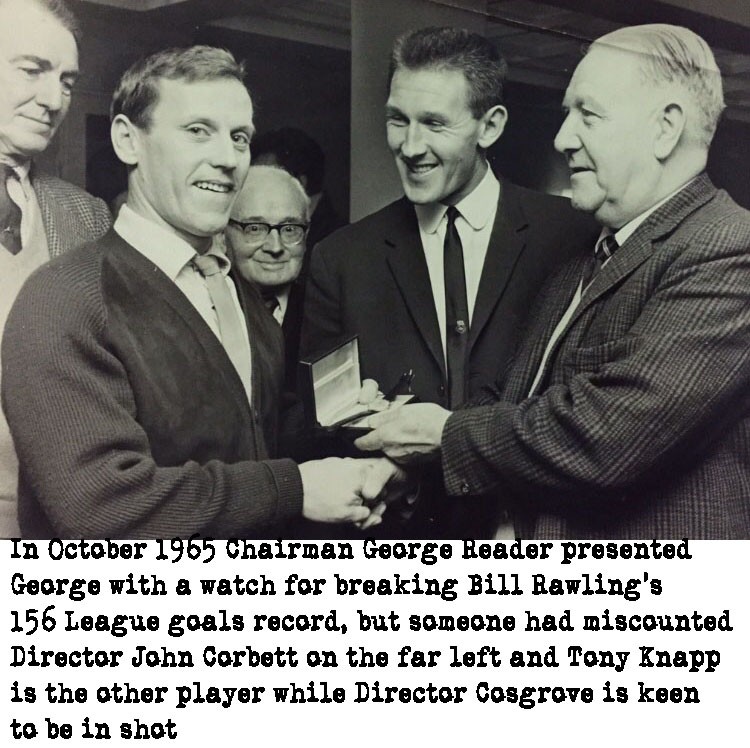
It was, by any standards, a brutal disposal of a player who was nearing Bill Rawlings’s club record for League goals and whose goals-per-game ratio was second only, post-war, to that of Charlie Wayman.
George remained “quite bitter” about the way he “was kicked out of the door” – even if it was his “own stupid fault for going,” against plenty of advice to stay. He mused that he may have ignored that advice to “spite” Ted Bates, for whom he didn’t have a good word to say. He remained especially irked by Bates’s failure to bring “a bit of stability at the back” to a side that scored so freely. If only Bates had reinforced his defence, George reasoned, Southampton would have been in Division I and he would have been more “in the public eye.” He might even have been capped for Scotland. As it was, his main show-case moment for the Saints was the 1963 semi-final v Manchester United.
He blamed his disappointing performance on Paine who “never passed the ball to me, all day,” preferring to show off to the selectors, George reckoned, in a manner that won him his first full cap, soon after. That was not the only time he fell out with Terry – he found it “easy” to do so – yet each of them recalled happy Sunday lunch-times at the Waterloo Arms, the Freemantle pub George was running, in retirement. Terry would bring in a basket of Sunday surplus from his fruit-and-veg shop, to be raffled. When Terry became John Sillett’s player-coach at Hereford, soon after, George scouted for them. He would again do so when Sillett and Paine were at Coventry in the late 1980s. Meanwhile, he had been on stand-by to join John and Terry at Nottingham Forest, as “Chief Scout and things like that.” Sillett was in the frame for Forest’s managerial vacancy in January 1975, but lost out to Brian Clough.
George got out of the pub trade in 1990, to become a sub-postmaster in Edinburgh, but soon returned to Southampton, to take over the Star and Garteralso in Freemantle. After which, he became a taxi-driver. If you ever encountered George in one of his bars or one of his cabs, you may well have had the good fortune to be treated to some insightful angles on his footballing values and philosophies. The patter won’t have been pretty: George told it as he saw it, just as he did as a player. But Paine admired that tendency and wishes that more of their team-mates had been as “expressive” as George “about the way the game should be played.”
One of George’s sons, Colin, was on Bristol City’s books during 1977-78, before having a couple of outings with Hereford United.
- Blairhall Colliery
- Dunfermline Ath 1952
- Leeds Utd Mar 1957
- SOUTHAMPTON Jul 1959
- Leyton O Mar 1966
- Aldershot Dec 1966
| Competition | Apps | Sub | Goals |
|---|---|---|---|
| FOOTBALL LEAGUE | 254 | 0 | 154 |
| FA CUP | 18 | 0 | 19 |
| LEAGUE CUP | 15 | 0 | 5 |
| HER | 4 | 0 | 2 |
| Total | 291 | 0 | 180 |