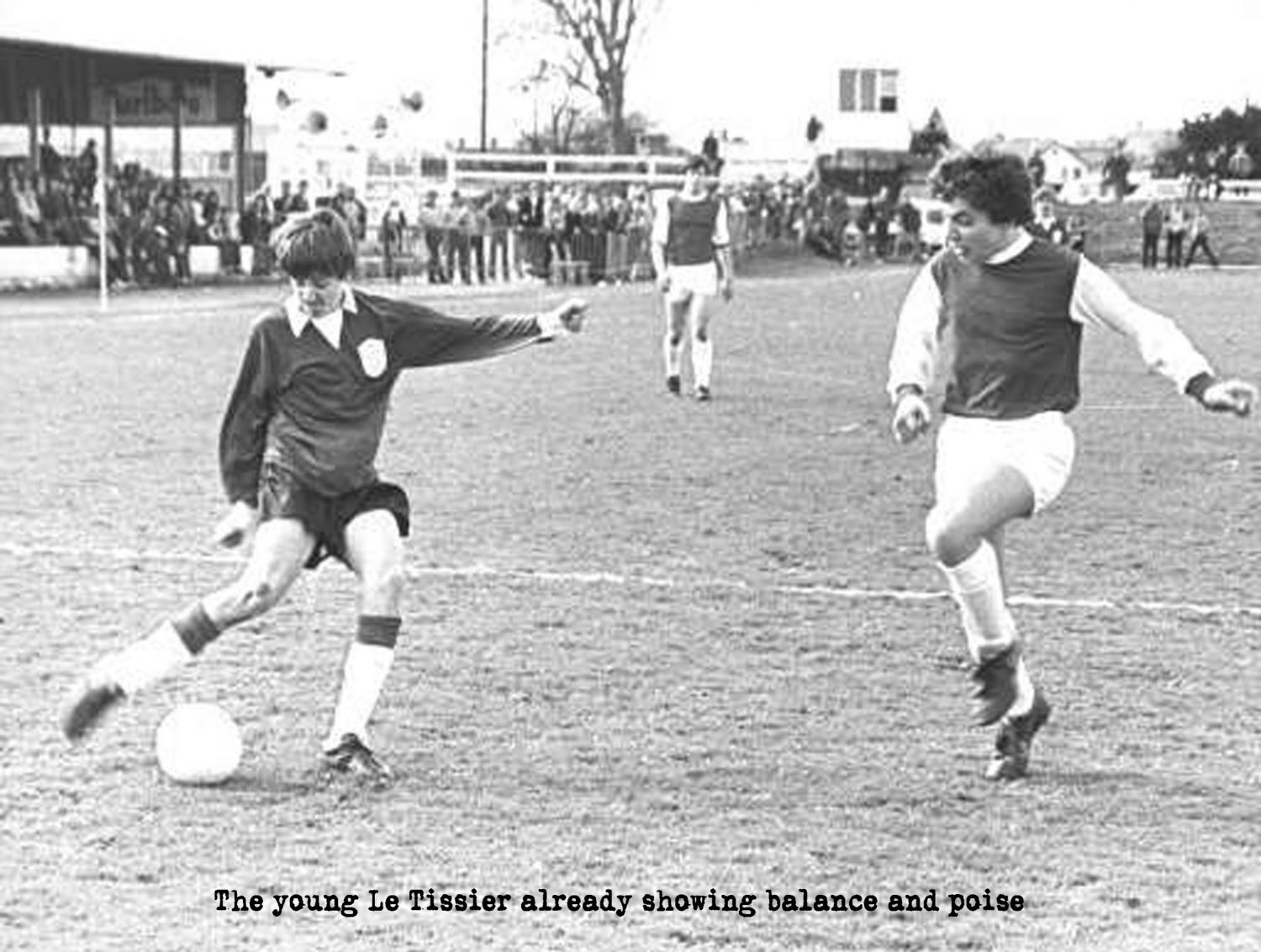
14 Oct 1968
St Peter Port, Guernsey
46278 Sub
1986 — 2002
209
Reminiscing in 2013 – at yet another of the signing sessions he has generously undertaken on behalf of Hagiology Publishing – Matthew Le Tissier claimed to have no regrets at never having won medals or silverware while with Southampton, his one and only club: he’d amassed enough as a schoolboy in Guernsey. Why ask for more? Matt has confessed, however, to envying how many times Terry Paine had played for the one manager: Ted Bates.
“Had Alan Ball been my manager from the very start of my career to the very end, then,” Matt contends, “I would probably have played a lot more games, scored a lot more goals and maybe been in the England squad a bit more – who knows?”
Who knows, indeed? On the matter of his eight caps, Matt reasoned, in his testimonial programme, that he’d perhaps damaged his cause by twice crossing Glenn Hoddle: by refusing to join him at Chelsea; and by declining to go under the spell of Eileen Drewry. Or was it a case, as Jonathan Wilson hinted in his Anatomy of England’s internationals, that “Hoddle couldn’t bear not to be the most gifted player still on the training pitch”?
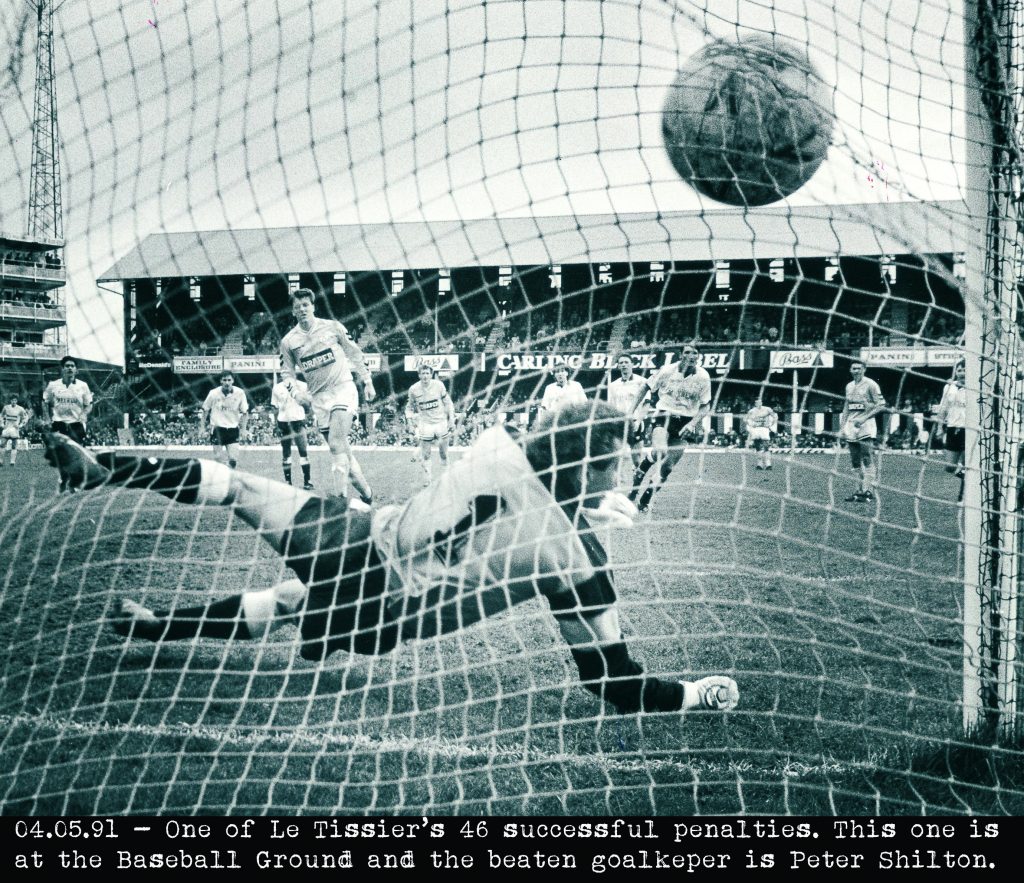
As for his club career, the statistics lend support to Matt’s supposition. During Ball’s season-and-a-half as Southampton’s manager, Matt scored 35 goals in 57 First Division starts. Those goals included unstoppable free-kicks, like the “Great Escape” curler at West Ham in May 1994, and outrageous efforts in open play,
notably the 30-yard lob that bamboozled Tim Flowers at Blackburn, in December 1994, when Matt had three goals in the BBC’s shortlist of 10 for Goal-of-the-Month.
And yet, to dwell on the wonders of Matt’s goals for Ball is to miss two points. First, his repertoire also included some notable “assists” – for the likes of Nicky Banger, Franny Benali, Ronnie Ekelund and Ken Monkou to name but four memorable occasions. Secondly, Matt had enjoyed a high-scoring spell under Chris Nicholl, who had given him his debut early in the 1986-87 season. Over the next three seasons, he had his moments, but Danny Wallace’s departure in September 1989 was a watershed. It paved the way for an unorthodox system, with Le Tissier and Rod Wallace out wide and Alan Shearer or Paul Rideout – or maybe both – upfront.
This format produced a startling distribution of goals. From the moment of Danny’s departure to the end of the following season, Southampton played 63 League games with Le Tissier and Rod Wallace wide, with Shearer and/or Rideout between them. Le Tissier scored 37 goals, Wallace 30, Rideout nine and Shearer five. With Shearer “beavering away, doing all the hard work,” Matt explains, Wallace and he could “nick all the goals.” The format was Nicholl’s way of acknowledging that
Matt didn’t “really fit modern systems” In this solution, Matt would “start off as a winger, but he couldn’t be tied down. You had to give him freedom to move on the field, as he saw fit.”
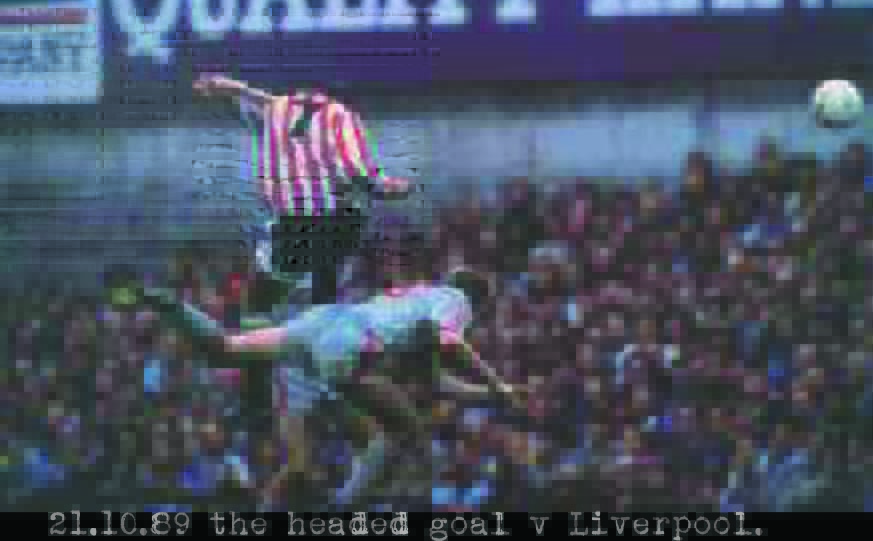
Relying upon Jimmy Case’s way of “controlling the game,” as Matt puts it, Rodney and he had the freedom to cut in and “go for goal.” The ultimate expression of how it could work was surely the 4-1 home win in October 1989 v Liverpool. Matt recalls how the two of them “by-passed Alan and Paul and just crossed for each other at the far post-to score.
They really made it look that simple. It couldn’t last. In the summer of 1991, Wallace was sold to Leeds and Ian Branfoot replaced Nicholl as manager. Shorn of Wallace, Branfoot sought to release the unfulfilled scorer in Shearer, bringing in Iain Dowie as a target-man and freeing Shearer for runs down the channels.
Matt’s freedom was conversely reduced. The consequences can be seen in the statistics. Shearer top-scored in the League in 1991-92, while Le Tissier limped in third – although he outscored Shearer in the Cups, as the Saints reached the ZDS Final and the FA Cup quarter-finals. The latter competition was a personally disappointing one for Matt. The Fourth Round replay at Old Trafford went to penalties. Having become the Saints’ penalty-taker, Matt so far had a 100 per cent record. But, hoping to “get the glory at the end,” he opted to go last.
He became redundant when four team-mates scored and United failed twice. The consummate penalty-taker – he would finish with 47 out of 48 – Matt would never get to participate in a shoot-out. Then, two replays later, Southampton were leading 1-0 at Norwich when, as the Echo put it, “Le Tissier’s brain left his head” and he was red-carded for retaliation. Matt has no quarrel with the first of his two career-dismissals and takes the blame for blowing Saints’ chances of a second trip to Wembley that season.
The disappointments would continue. Shearer departed for Blackburn, leaving Matt to top-score yet again in the inaugural Premiership season. Even so,
he was not enjoying his football under Branfoot. But he calculated that he’d outlast the unpopular manager. And so he did.
Half-way through the 1993-94 season, the Board sacked Branfoot and brought in Ball. After his glorious 18 months under Ball, things would never be quite the same again. There’d be two more seasons in which he top-scored, singly or jointly, but his career had been fizzling out when,
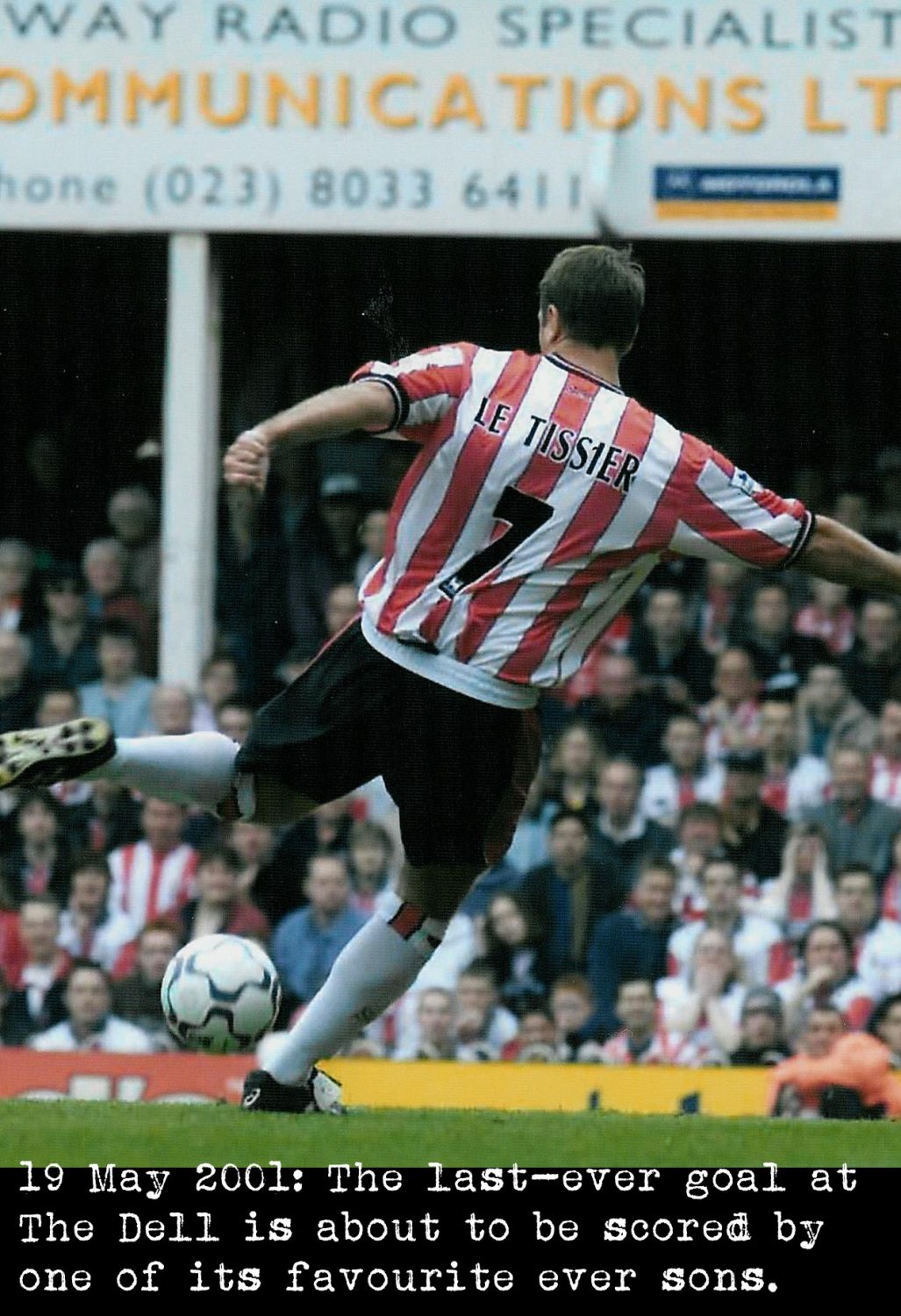
in the last League game at The Dell on 19 May 2001, he came off the bench to score an 88th-minute winner v Arsenal, with a trademark moment of magic.
Having opened the St Mary’s Stadium three months later, Matt would never start a game there. But, as the man himself said, he retired contented. He has, of course, continued to entertain, as one of Sky’s top pundits and as an after-dinner speaker. In between rounds of golf, with a handicap of four, he devotes a huge amount of time to charity work. And, in a blatant response to the conformist school of coaching, he has established Matthew Le Tissier Natural Coaching, designed to give kids, from U-7 to U-13, “an environment to bring out every last drop of natural talent.” In 2016 he and his good friend, Franny Benali opened a joint venture as football agents while in 2019 the club made him an ambassador. Whether or not Matt’s own natural talents would have prospered more if he’d only ever played for Alan Ball must remain a debating point. But more than one of his nine other managers has reasoned that there was another way he could have improved his career statistics: by leaving Southampton. Yet having argued that, Graeme Souness concluded that
“whatever it is he might have achieved elsewhere, he was very happy at Southampton – and what price is happiness”?
In recent years he has courted a certain amount of controversy with his conspiracy theories and unconventional and sometimes bizarre views. As a consequence some of the ardour in which he had been held by the fans has become tarnished although for many he remains a footballing idol.
- Guernsey Schools
- Vale Recreation
- SOUTHAMPTON app May 1985, pro Oct 1986
- Eastleigh Oct 2002
- Guernsey Apr 2013
- Sholing DoF Jun 2024
| Competition | Apps | Sub | Goals |
|---|---|---|---|
| F.LEAGUE/PREMIER L | 377 | 66 | 161 |
| FA CUP | 30 | 3 | 12 |
| LEAGUE CUP | 44 | 8 | 27 |
| OTHER | 11 | 1 | 9 |
| Total | 462 | 78 | 209 |