
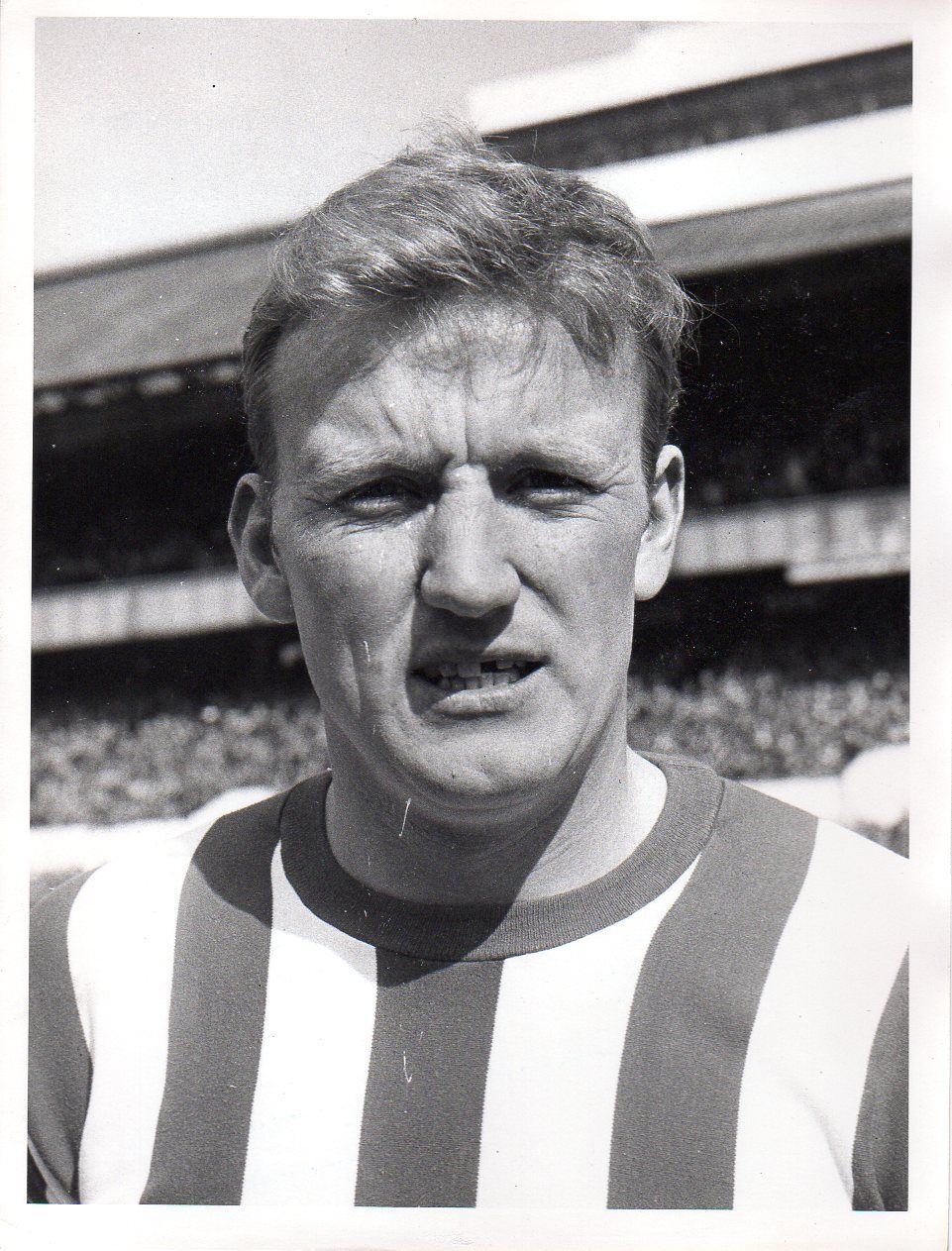
10 October 1940
Dundee
died: Seattle, USA 10 Jul 2021
2231 Sub
1967 — 1972
27
In January 1967, Ted Bates set his sights on Preston’s Howard Kendall. He lowered them when Preston demanded £75,000 and settled, come March, for the cheaper option of Blackpool’s Hugh Fisher. Kendall went to Everton in time to make his debut at home to Southampton, who included the debutant Fisher. Watching the Saints’ 1-0 win, that afternoon in March 1967, was the wing-half displaced by Kendall: Jimmy Gabriel, who had been prominent in Everton’s winning the First Division in 1963 and the FA Cup in 1966 and who had been twice-capped by Scotland. Bates now enquired after him, but Jimmy fancied commuting from Liverpool to play for Stoke City, a move recommended by his Goodison team-mate, Alan Ball, whose father was assistant-manager at Stoke.

When Stoke failed to firm-up, Bates renewed his pursuit. Warned by Ball that “you’ll not win anything, down there,” Jimmy wanted to see for himself.
As the train crossed the Hampshire hills, he was “impressed by how beautiful” the county looked in the summer sunshine.
And by the time his wife, Pat, and he had taken tea at the Bateses’ home – that ritual that Mary Bates so often hosted – Jimmy was ready to sign. Ball would be proved right – unless you count the Daily Express 5-a-side trophy – but Jimmy, “loved the challenge [of] helping the team to stay in the First Division” and took “a tremendous pride” in doing so. And what a triumph for Bates’s financial acumen! Gabriel cost £42,500 (see below).
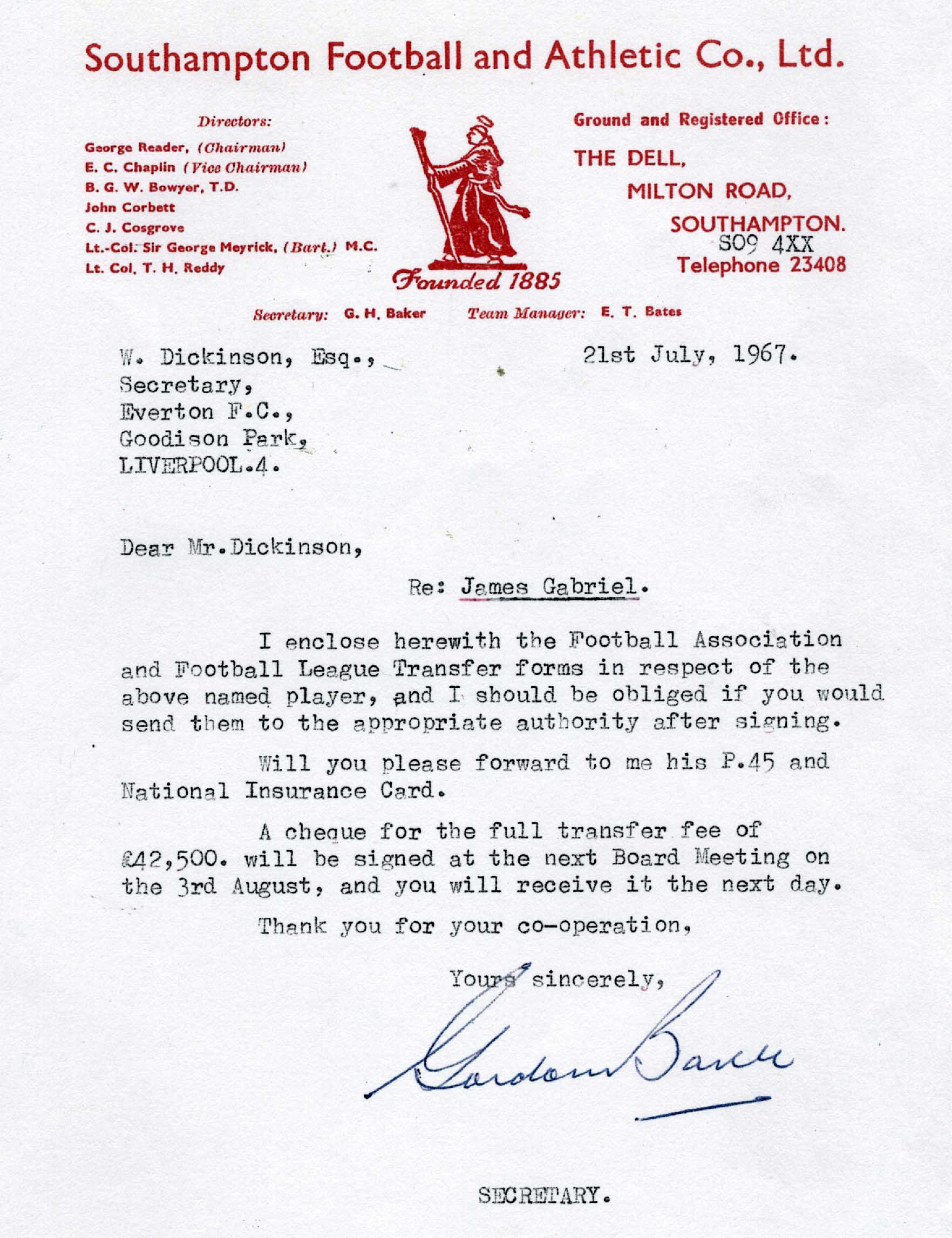
Add that to the £28,500 paid for Fisher and the total outlay is still £4,000 shy of Preston’s asking price for Kendall – never the mind the £85,000 that Everton eventually paid for him.
Jimmy could have stayed at Goodison as a centre-back, but he wished to remain in midfield. Yet Bates handed him the No.5 shirt. In the opening game at Newcastle – a 3-0 defeat – Jimmy was marking Wyn Davies. On his way into the Dell dressing-room, two games later, he was feeling demoralised by the struggle to defend, at 5ft 10ins, “in the land of the giants”.
But approaching him was Bates, who told him that “seeing you coming to play for my team makes me feel so good.”
Jimmy was “lifted – you’re never too old to hear that sort of stuff” – and felt he was coping among the giants until Leicester City won 5-1 at The Dell, come mid-October. Jimmy was moved to midfield for the next third of the season – until Bates bought a big No.5: John McGrath. Jimmy slotted in at No.6, thereby finding his “best position for Southampton – as assistant to Big John.”

The pairing suffered, though, from Jimmy’s versatility, which meant that Bates might switch him to centre-forward, whether remedially at half-time or occasionally as a starter. The role was “exciting”, but Jimmy likens it to “a dog standing on its hind legs: you can’t be like that all of the time. When you come down on your forepaws and the excitement leaves you, you realise what a hard job it is and you’re thinking ‘I’m really not qualified for this role.’”
But, then, nor was he “qualified” to play at right-back. When he did so, aged 31, in November 1971 at Goodison, he was, he reckons, “the hole that Everton used” to romp to an 8-0 win. Yet he was there again, the next week, expected to stop George Best notching a hat-trick in Manchester United’s 5-2 win at The Dell – although he did score against United for the third consecutive time. That would be his last game v United. By the time of the “return” in April 1972, Jimmy had made way for the latest recruit from Dundee: Jim Steele. When the merits of Saints’ classy “sweepers” at No.6 are debated, both men are in the frame. But Gabriel was a shoo-in, when Terry Paine picked, for his 2008 biography, a Saints XI of his era. For Terry,
Jimmy was “an absolute class act – an outstanding footballer… a very intelligent player [who] loved to play… but, more, he wanted to win.”
Mick Channon was similarly enthusiastic in his Man on the Run. Jimmy was, for him, “everything I love about a footballer – a stubborn devil [who] wanted to be the best.”Even as he was earning such accolades as a player, Jimmy believed that he had a role in bringing on the youngsters. Although he was only 26 when he arrived at The Dell, he reasoned that, like Terry Paine, then aged 28, he was “experience-old” and that the two of them could effectively “coach” defenders and attackers, respectively.
Which is why he objected, rather pointedly, to the appointment of first John Mortimore and then Stuart Williams to an assistant-manager position that included a coaching role. He didn’t “think it was the time, at Southampton, for coaches” and these premature appointees were “stepping on the ground that belonged to Terry and me.”
Fighting stuff! But Jimmy took it further, to the extent that he fell out with Williams over team-selection and tactics. Which perhaps helps to explain why he needed to leave in 1972, even though he still had enough in him, he reckons, to have prevented Southampton’s relegation two years later. As it was, Bournemouth would have the benefit of Jimmy’s final playing years, before he decided that the time had come for coaches and that he was going to be one of them – mainly in the USA, latterly at the University of Washington in Seattle, but with return-spells both at Bournemouth and Everton.
- SS Peter & Paul Sch
- LawsideAcad
- Tyneside Boys Club
- Dundee NE
- Dundee prov contract Oct 1956,pro Jan 1957
- Everton Mar 1960
- SOUTHAMPTON Jul 1967
- Guernsey temp coach on loan May 1971
- AFC Bournemouth Jul 1972
- Swindon T loan Oct 1973
- Brentford Mar 1974
- Seattle Sounders cs 1974, player-coach Apr 1976
- Argentina coaching 1979
- Phoenix mgr
- San Jose Earthquakes coach/mgr-coaching director 1981
- Washington State youth mgr-coaching director/national coach of coaches USA
- AFC Bournemouth asst-mgr May 1987
- Everton asst-mgr Jun 1990, caretkr-mgr Oct 1990, res coach Nov 1990, caretkr-mgr Dec 1993
- Washington State youth various coaching positions from 1997 in Seattle
- U of Washington and Seattle Sounders
| Competition | Apps | Sub | Goals |
|---|---|---|---|
| FOOTBALL LEAGUE | 190 | 1 | 25 |
| FA CUP | 17 | 0 | 1 |
| LEAGUE CUP | 9 | 0 | 0 |
| EUROPE | 7 | 0 | 1 |
| Total | 223 | 1 | 27 |
