
21 Feb 1869
Blackburn
died: Sheffield 12 Mar 1917
7
1897 — 1898
0
Aided by a myth about his place of birth, Jack Reynolds established an international record that is unlikely ever to be broken. His right to play five times for Ireland in 1890-91 was supported in an 1891 profile in the Ulster Football and Cycling News, claiming that he had been born in Ireland, but had emigrated to Lancashire as a boy. The fact that he was born in Blackburn to Irish, Catholic immigrants is not in dispute, but when he first set foot in Ireland has remained a matter for argument. Some say his father was a soldier, posted from Lancashire to County Antrim, where young Jack attended school, but that he then returned to Blackburn in time to play local football and to graduate to Blackburn Rovers’ Reserves. The alleged army connection is not borne out by Jack’s birth certificates and census records, in which his father appears in various manual occupations. And, unless his parents decamped to Ireland and came back to Blackburn between the censuses of 1871 and 1881, Jack won’t have been at school in Ireland, either.
Whatever, we know from the latter census, that 12 year-old Jack had left school and was working as a cotton-weaver in Blackburn. By the age of 17, he was playing for Blackburn Park Road, when they were drawn at home, in the FA Cup, to Irish League Cliftonville. Jack scored in a 2-2 draw and duly travelled to Belfast in October 1886, for a 7-2 drubbing in the replay. All of which explains why Jack’s work-in-progress biographer reasons that this was the teenager’s first visit to Ireland. He was very soon there, again, now as a soldier. Having joined the East Lancashires in December 1886, he was posted, come February 1887, to the north of Ireland.
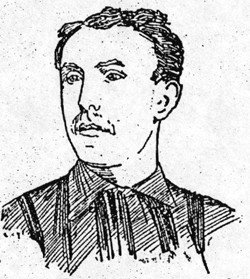
He continued to play for his regiment – and as a guest here and there – until Distillery bought him out of the army. After only a few games for them, however, he joined the Belfast club, Ulster FC. He was now calling himself “William”, a good Orange name for a member of this Protestant club. But he also needed to maintain the pretence that he was Irish, as the Irish FA required clubs entering its Cup competition to field at least nine Irishmen. It suited Ulster, a club with several Scots on its books, to be able to play “William” Reynolds who, as that Ulster News profile would remind its readers, was Irish-born.
The Irish FA clearly accepted that false identity – hence the five caps – and must have welcomed his versatility: his first game was at centre-half; in the second, he was a scoring outside-left. But his fourth appearance for Ireland, a 6-1 defeat by England at Molineux, put him on display to Football League clubs, with the result that he was very soon playing for West Brom as an Englishman called “Jack”, even if the fans were affectionately calling him “Baldy”.

In his first full season, the Albion, with another future Saints, Roddy McLeod in their team, won the FA Cup, beating Aston Villa 3-0. A fortnight later, he played for England – the first of eight appearances, nearly all of which would be at wing-half.
He thus became the first – and, so far, only – footballer to play, as a full international, for both Ireland and England.
see Edgar Chadwick profile for England team photo).
And his goal against Wales in 1893 made him the only man, barring own goals, who has ever scored both for and against England. Neither record can be equalled, of course, under current rules. In 1892, he joined Villa. In his four seasons with them, they won a trophy each season – either the Cup or the League or, in 1897, both. Their 1895 Cup win was against West Brom, giving Reynolds yet another odd record: he became the first man to win the FA Cup with two different teams, each time at the expense of the other one. With five medals to his name, he left Birmingham for Glasgow. Failing to establish himself in Celtic’s Scottish League side, he departed, in mid-season, for Southern League Southampton.
This was territory familiar to his older brother, James: while serving with the Medical Staff Corps at Netley, James had played in their side that beat Saints’ Reserves in the 1891 Hants Junior Cup Final. After only seven appearances, all at right-half, Jack left Southampton for spells with Bristol St George in the Western League and with Sheffield League Royston. In April 1902, he arrived, listed as an Englishman on a ship packed with Irish immigrants, in Auckland, New Zealand and was very soon playing for North Shore. But before long he was with the less successful Grafton. That was short-lived, too, and he was soon back in England, playing once for Stockport in Division II, before going non-league with Willesden.
After which, he became a coal-miner, near Sheffield. By the time he died, of heart failure, aged 48, he was living in reduced circumstances in a Sheffield lodging-house, where his body lay undiscovered for two days. He was buried in an unmarked grave – a most undistinguished end to the life of a leading footballer, whose off-field activities would have titillated today’s tabloids. He was a drinker and a gambler, whose team-mates refused to play cards with him on train journeys. Added to which, his sexual exploits – thrice hospitalised, as a soldier, with VD; and pursued, in a Birmingham court, for the maintenance of an illegitimate child – would surely have made him a front-page celebrity. Jack, alias William, Reynolds – record-breaker, myth-maker and reprobate – became the subject, in 2006, of an academic paper at the University of Ulster: “How to play football, win friends and die young,” by Dr Neal Garnham.
- Blackburn Park Road
- Witton
- Blackburn Rovs 1884
- Blackburn Park Road 1886
- East Lancs Regiment Dec 1886
- Distillery 1888
- Ulster 1890
- West Bromwich Albion Mar 1891
- Aston Villa Apr 1893
- Glasgow Celtic May 1897
- SOUTHAMPTON Jan 1898
- Bristol St George May 1898
- Royston 1899
- North Shore (New Zealand) Apr 1902
- Grafton (New Zealand)
- Stockport Co cs 1903
- Willesden T Aug 1904
| Competition | Apps | Goals |
|---|---|---|
| SOUTHERN LEAGUE | 2 | 0 |
| UNITED LEAGUE | 5 | 0 |
| Total | 7 | 0 |