10 Oct 1950
Islington, London
52
1978 — 1981
14
“One man went to mow” is not a familiar refrain on the terraces, but one man who heard it a lot was Charlie George, who lived and played in an era when even elite footballers cut their own lawns. Islington-born, he made his name on his own doorstep, in the course of 179 appearances for Arsenal, in which he scored 49 goals – none more memorable, surely, than his extra-time winner in the 1971 FA Cup Final, a 20-yard screamer that clinched the “double” for the Gunners.

Whereupon, he lay down, arms aloft, and waited for his team-mates’ congratulations – an iconic image, so often seen on TV and judged, in a scientific analysis for FA Cup sponsors, E.ON, to be the most energy-efficient goal-celebration in the competition’s history.
It was the kind of flamboyant action that would reinforce Charlie’s cult-hero status at Highbury – which was not entirely a good thing if your manager was
Bertie Mee, a man “deeply suspicious”, as his biographer, David Tossell puts it, of “the kind of hero-worship” that George attracted.
In his opinionated autobiography – for instance, he denounces Mee’s signing of Alan Ball as “a waste of money” – Charlie is unrelenting in his criticisms of a “pompous” manager, who “couldn’t handle individualism when it came with a touch of attitude.” Tossell’s forensic appraisal of the Mee-George relationship is most balanced. Mee’s coach, Don Howe, felt it wasn’t easy for a disciplinarian boss to cope with
Charlie, who “became a star before he was ready to become a star,”
but Bob Wilson thought a less-rigid manager might have allowed Charlie “to do his own thing.” Then again, Eddie Kelly spoke up for Mee as a father-figure. When interviewed for the biography of Ted Bates, Mee, who had been a war-time guest at Southampton, confessed that he eventually felt able to off-load Charlie, when some of his team-mates suggested it was time to get rid.
Transfer-listed during the 1974-75 season, Charlie told the News of the World that he now rarely spoke to Mee and “we’d both be better off if he sold me.” Even so, he complains, in his autobiography, that Mee “virtually drove me out.” All of which contrasts with the mutual respect Charlie reckons he enjoyed with Dave Mackay at Derby and Lawrie McMenemy at Southampton. He had his moments at Derby – notably four goals in two legs v Real Madrid – and was voted the Midlands Footballer-of-the-Year in 1976. He fancied Forest as his next club, but Derby were never going to sell him to Brian Clough. There were objections, too, to his signing for McMenemy, although these came from the Southampton directors.
But the manager, feeling in need of “a bit of flair and excitement,” as he put it in his Diary, prevailed over his Board. And so, after weeks of wrangling, George put pen to paper in December 1978.
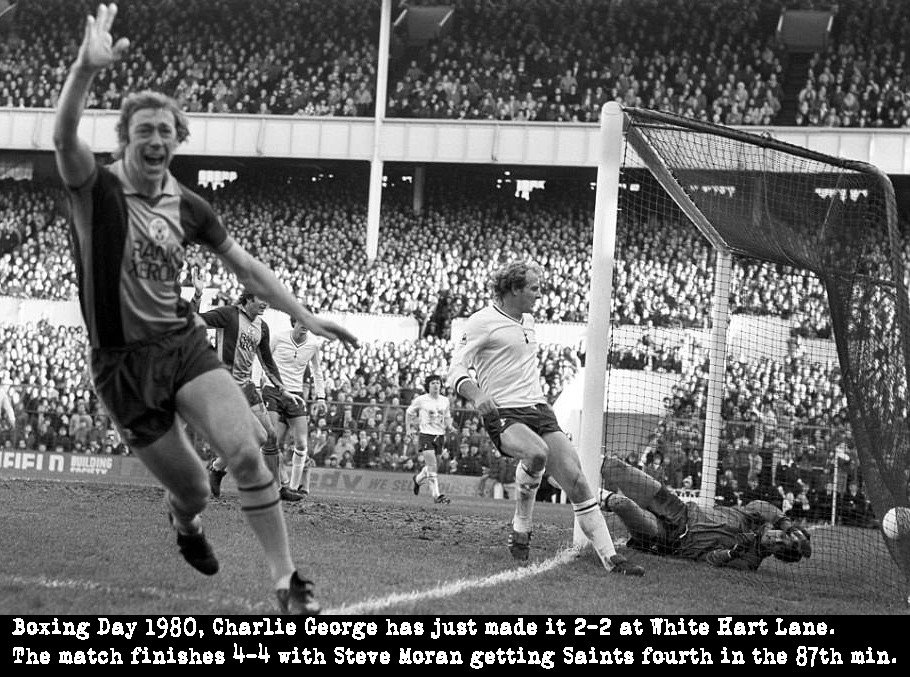
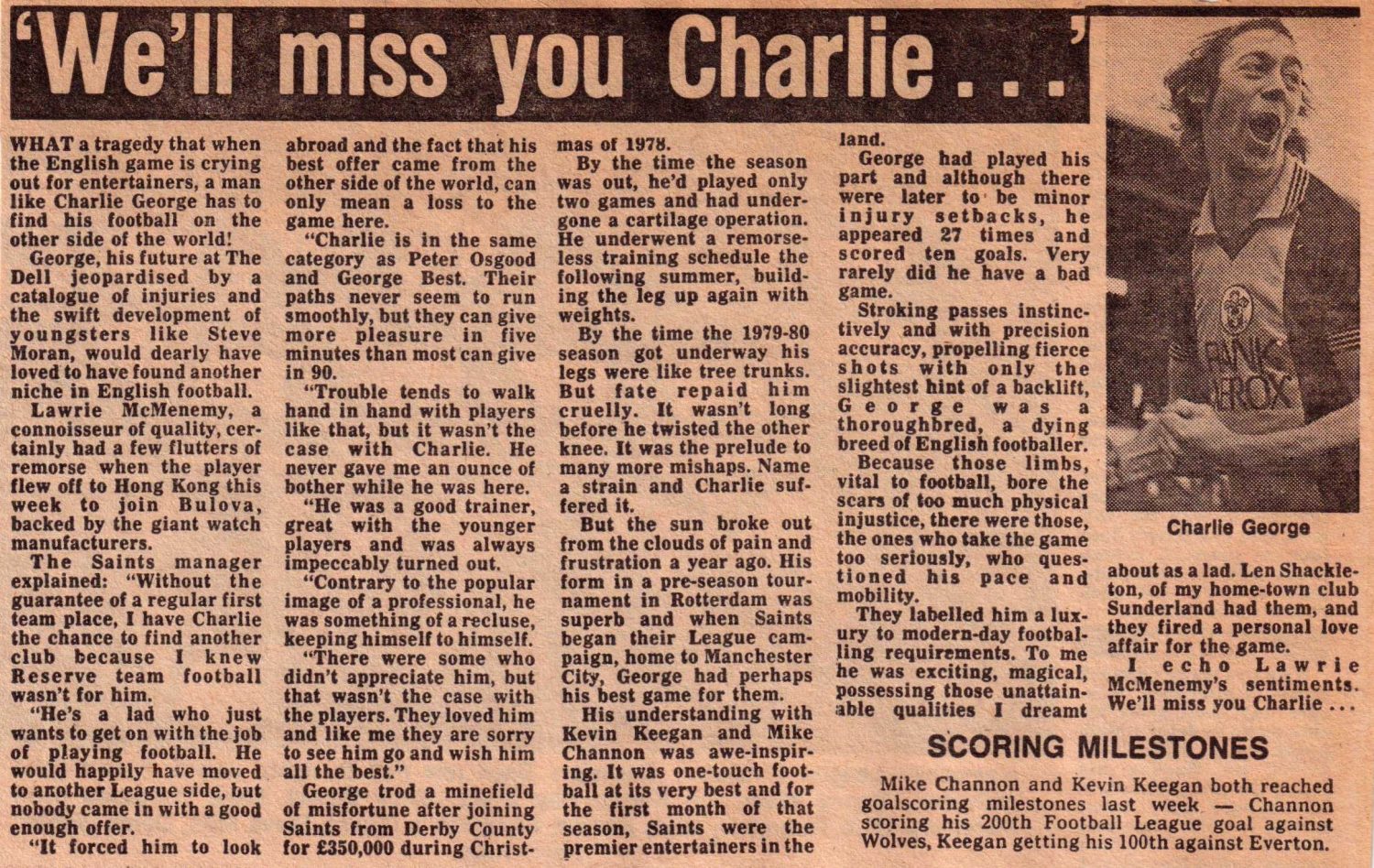
It would be August, however, before Charlie’s flair could create any excitement at The Dell. His appearances in 1978-79 were limited to the Saints’ exit from the FA Cup in a Sixth Round replay at Highbury and two League games away from home. His knee was the problem. Charlie had been relieved that it ever passed the club’s medical inspection, but it was still puffing up in March, a busy month of Cup-ties, towards the end of which McMenemy decided the side needed “a new face”. Charlie not only started the 1979-80 season but – with the new arrival, Kevin Keegan, taking Boyer’s place – the next one, too. He would continue to be troubled by injuries, though, over those two seasons, in which he missed exactly half the League fixtures. As Mick Channon characteristically put it, in the Saints’ Official History video,
if Charlie had “been a horse, they’d have shot him.”
His injuries included the loss of a finger in the lawn-mower accident that provoked the “one man” chant. In summary, “everything” about the club and living in Hampshire was, he says, “perfect, apart from the frustration” of not playing enough. For his part, McMenemy was reflecting in the Echo, 21 years after Charlie’s departure, that he was “undoubtedly one of the all-time greats and a terrific fella.” Charlie’s post-Dell career involved plenty of changes, but only 11 more League appearances, most of them back at Derby.
He ran a pub near New Milton for a while and was then a partner in a garage business. After that had failed, he became a match-day “meeter-and-greeter” at Highbury and has latterly been employed full-time, hosting the “Legends” tours at the Emirates Stadium. Charlie’s one appearance for England in 1976 was v the Republic of Ireland at Wembley. He regrets not having exploited an Irish grandfather, whom he never met, to play for the Republic, instead.
- Holloway Comp Sch
- Islington
- Middlesex Schs
- London Schs
- New Middleton
- Arsenal app May 1966, pro Mar 1968
- Derby Co Jul 1975
- St George Budapest (Australia) loan May 1978
- SOUTHAMPTON Dec 1978
- (Nottingham Forest loan Jan 1980
- Bulova (Hong Kong) Sep 1981
- AFC Bournemouth Mar 1982
- Derby Co Mar 1982
- Dundee Utd trial Sep 1982
- Coventry C Aug 1983
| Competition | Apps | Sub | Goals |
|---|---|---|---|
| FOOTBALL LEAGUE | 44 | 0 | 11 |
| FA CUP | 5 | 0 | 0 |
| LEAGUE CUP | 3 | 0 | 3 |
| Total | 52 | 0 | 14 |