

15 Sep 1939
Southampton
4011 Sub
1956 — 1970
40

First taken to The Dell in 1947 the eight year old John Sydenham’s idol was Eric Day. Less than a decade later the successful Southampton Youth team of 1956-57 had Terry Paine on the right wing and John Sydenham on the left. But when Paine was introduced to the first team in March of that season, the manager, Ted Bates, played him on the left. Bates switched him to the right, though, for the last game of the season and gave John his debut on the left.
Although he’d just won three caps in the International Youth Tournament in Spain, John was nevertheless surprised when Bates told him that he’d be playing in the first team. He recalls saying “something like ‘you’re joking.’ He looked at me and said ‘son, do I look like Charlie Chester?'” And on that note, Bates began a long-term dependence upon this pair of home-grown wingers, through two promotions and into Europe. It wasn’t all plain sailing, though. First, John would have a minor share of the No.11 shirt, over the next two seasons, until John Hoskins relinquished it.
Then, after making the position his own in 1959-60, he came up against a new obstacle: he was called up for National Service. He was not pleased, as he explained in Ron Hickman’s book, The Call-Up, to be thereby “putting my career in jeopardy.” He was expecting Paine soon to follow him, but Terry dodged the draft by successfully exaggerating a problem with his ears. There was a double whammy for John, in that Harry Penk, bought to deputise for him while he was at RAMC Crookham, had also been exempted from the call-up by dint of playing up his hearing difficulties. In fact, John managed to get more games than Harry in 1960-61, but spent most of the following season in the Reserves. He wasn’t really fit for first-team football, thanks to the wrong kind of physical training at Crookham and to having to play too many games at so many army levels.

Having completed his National Service, feeling that it had made him “more disciplined” and was “the best thing that could have happened to me,” John walked straight back into the No.11 shirt.
But Penk had demonstrated an alternative way of using a No.11. As he puts it in Dell Diamond, he could “chase down fast opponents and put them under pressure” – not as a one-off, the way that Hoskins had been expected to tackle back and help to curb Stan Matthews in 1953, as recounted in his profile, but whenever the occasion demanded. There’s the rub. When asked whether he might have been similarly deployed to help mark Matthews in 1959, John retorted that such an expectation “would have been a pretty sad day, I think, for the club.”
He prevailed as an attacking force, however, seldom missing a game all the way through to promotion to the First Division in 1966 (check scrapbook section)
But now, in the aftermath of Alf Ramsey’s “wingless” winning of the World Cup, Bates bought David Thompson, another wide man in the Penk mould. John would mainly continue to hold his own, though, until Bates began to experiment with other ways of filling the No.11 shirt, including handing it to an extra centre-back. Yet then, in a defiant hoorah for attacking on away territory, Bates brought John back for a memorable afternoon at Old Trafford in August 1969. Running the hosts’ Shay Brennan ragged, John laid on the crosses for Ron Davies’s three headed goals. It was pretty much his swansong. Come December, Bates signed Tommy Jenkins, a rather less direct winger. Davies certainly appreciated John’s ability to get a cross in when moving at his scorching pace. His crosses may not have been as accurate as Paine’s, but in picking John in his All-Time XI, Terry emphasised the value to the team of a winger who “could take you so quickly” from defence to attack
Having joined that select band of players who’ve played 400+ times for the Saints, John wound down his League career at Aldershot, after which he had four non-league clubs, book-ending a stint in Australia. He then emigrated to Perth in Western Australia, where he set up an insurance consultancy, while taking up the odd football post into his 50s. Then, in 2002, he began to scout officially for the club. Two of his recommendations who weren’t pursued – Brett Emerton and Chris Herd – went on to make it in the Premiership.
After 10 years, John felt that this work “was wearing me out.” He’d “got tired of all the travelling,” which included bringing trialists over from Australia, when he didn’t want to be away from Tracey, his seriously-ill daughter. Tracey has recovered and, in 2014, John and his wife, Jean, were able to relocate to Mornington about an hour’s drive south from Melbourne. In 2020 John reported that they were both very happy and also counting their blessings the bushfires had not affected their area.
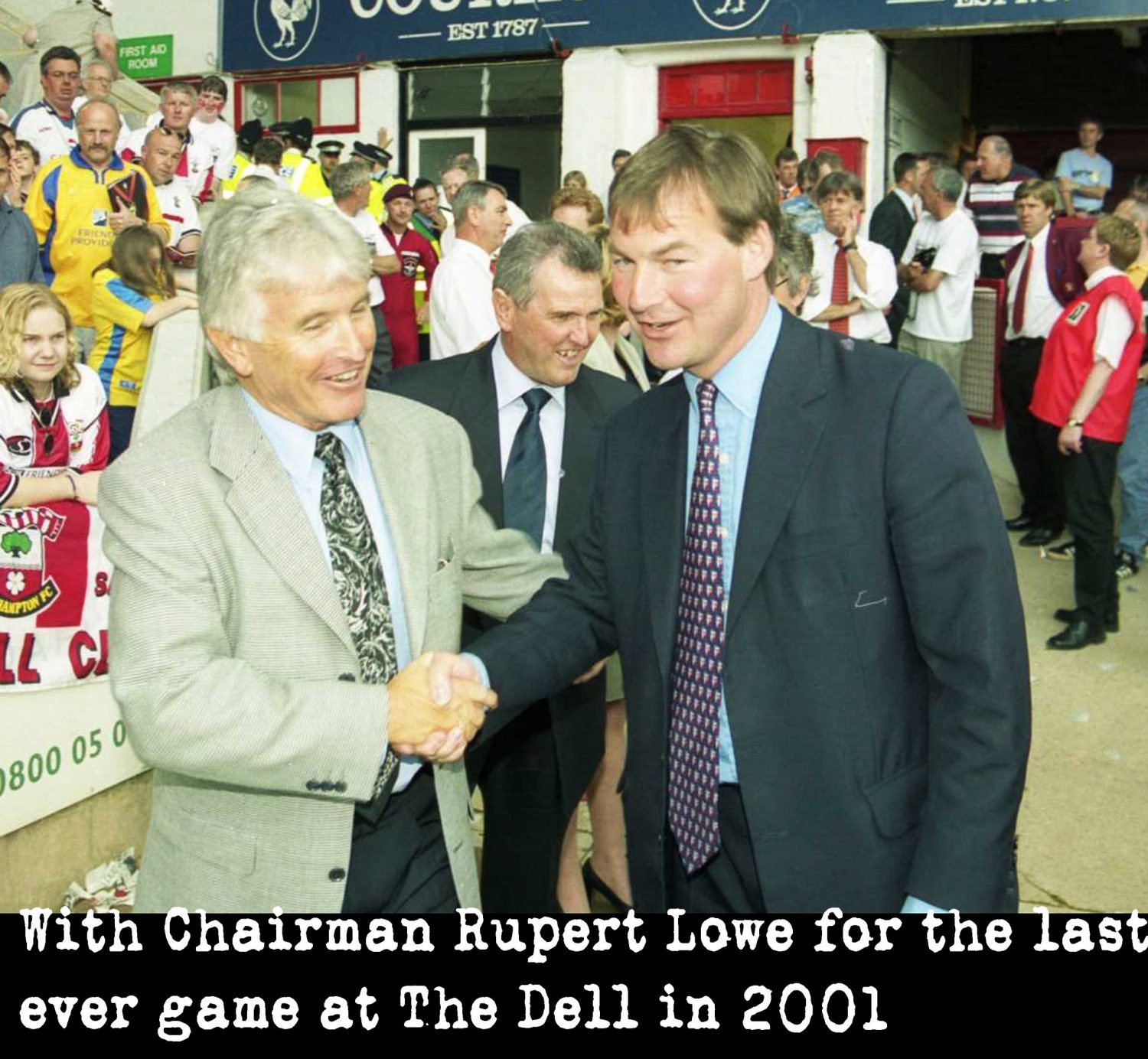
Please check the following profiles for further images.
Derek Reeves Barrie Hillier Campbell Forsyth Tony Knapp Charlie Livesey- St Mary’s College
- Southampton Schs
- Hants Schs
- CPC Sports
- SOUTHAMPTON am Aug 1955, pro Apr 1957
- Aldershot Mar 1970
- Bath C Aug 1972
- Athena (Australia) player-mgr Apr 1974
- Newport (I of W) player-mgr Aug 1975
- Dorchester T Dec 1975
- AC Delco May 1976
- Athena player-coach 1980
- Waneroo (Australia) (Australia) mgr 1993
- SOUTHAMPTON scout in Australia May 2002
| Competition | Apps | Sub | Goals |
|---|---|---|---|
| FOOTBALL LEAGUE | 341 | 1 | 37 |
| FA CUP | 31 | 0 | 1 |
| LEAGUE CUP | 21 | 0 | 2 |
| EUROPE | 4 | 0 | 0 |
| OTHER | 4 | 0 | 0 |
| Total | 401 | 1 | 40 |


