22 Nov 1896
Chilvers Coton, Nuneaton
died: Southampton 13 Jul 1978
3
1920 — 1921
0
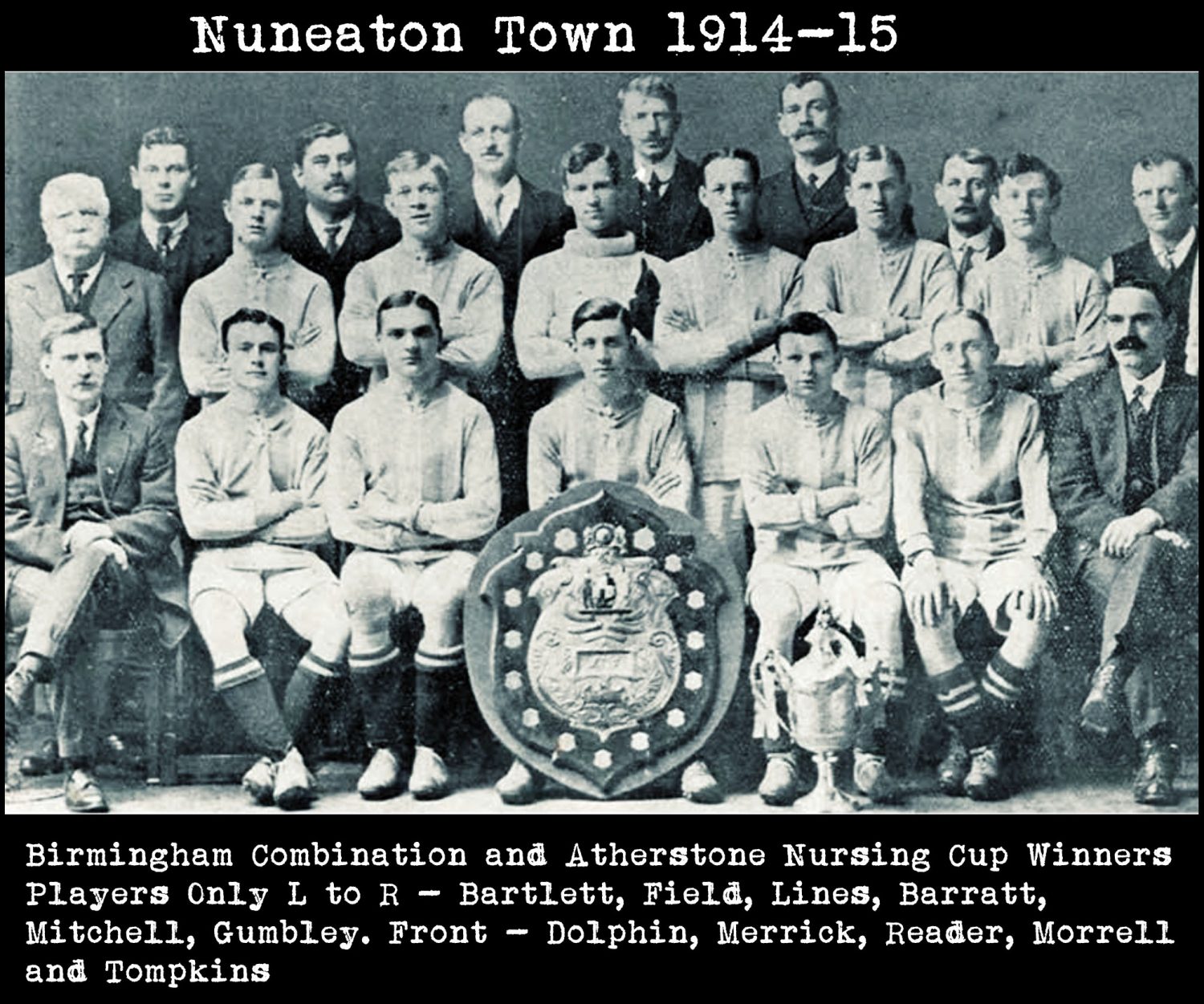
George Reader started his football career as a 17-year old with his local club Nuneaton Town and during their 1914-15 campaign he scored 13 goals in 21 games as they lifted the Birmingham Combination Championship and the Atherstone Nursing Cup (see above). He returned to the Nuneaton team after WW1 and scored a further three goals in four games before leaving for St Luke’s College in Exeter as a trainee teacher in August 1919.
While turning out for St Luke’s, (alongside Stanley Rous), George Reader was handily placed to sign, as an amateur for Southern League Exeter City in 1919.

When the Saints visited in January 1920, centre-forward Reader scored in a 4-1 home-win. Southampton paid £50 to bring him to The Dell, as they entered their inaugural season in the Football League. If you consult the profile of Bill Rawlings, you will have some idea as to how limited George’s chances of a game were always likely to be. Having made three appearances in his first season, he made it his last, by retiring from the professional game to concentrate on teaching at Central School and to play part-time, for a while, in the Hampshire League. If he had read the Football Echo write-up of his debut at QPR, a 0-0 draw, it was no wonder he chose to prioritise teaching. It pulled no punches.
“Judging on the game at QPR, Reader must have played far below his normal form or there has been an error of judgement. He did not do anything which was of real value to his side, for he seemed incapable of securing the ball unless it was given to him in such a way that the opposing half-back had not the remotest chance of intervention. He did not succeed in finding a single opportunity to send in a shot at all likely to score and Mitchell, Rangers captain, held him easily throughout the game. Reader was like a man playing in a class of football quite strange to him and too fast for control. He never strenuously contested for possession of the ball, it seemed to be obvious on Saturday that he requires much more experience before being given the difficult and important position of leader of the attack”.
He gave up playing completely in 1930 and took up refereeing, starting out with matches on the Common and becoming a Football League referee in 1939, just as the League closed down for seven seasons. Even so, there were some quality opportunities for him, in the form of two War Cup Finals, several “Victory” internationals and the Rest of Europe v Great Britain at Hampden in 1947.
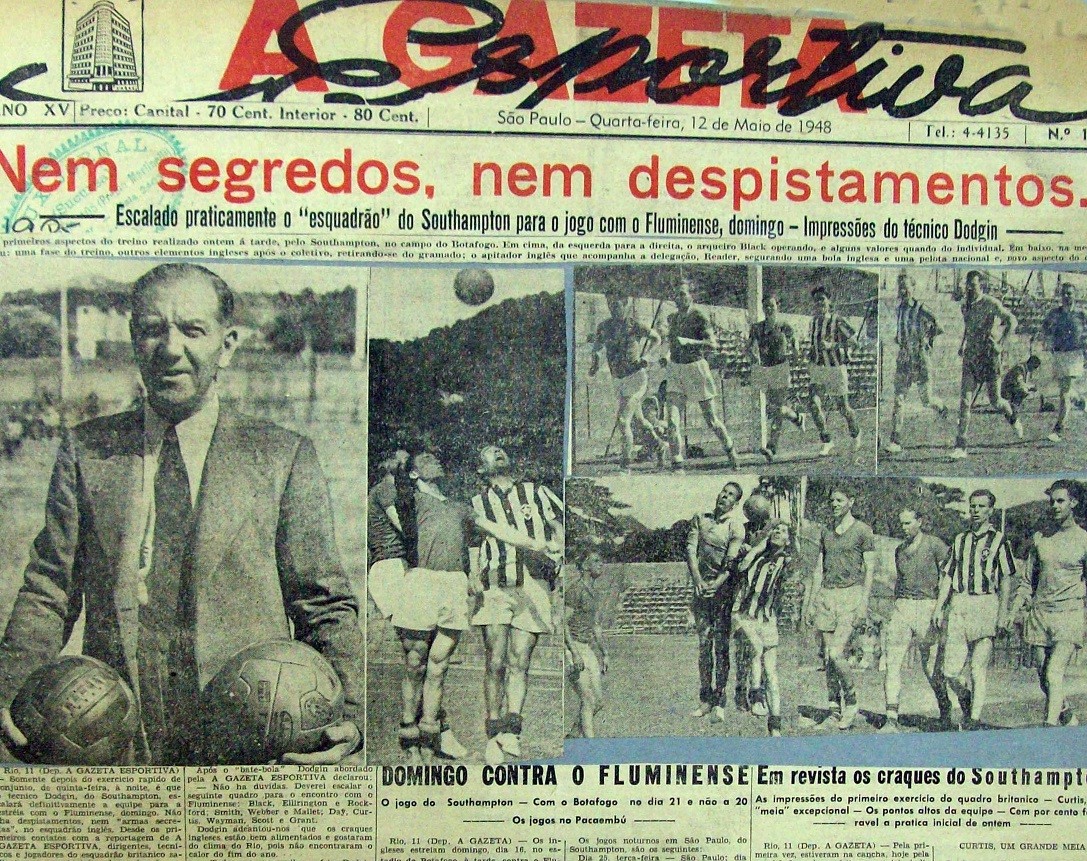
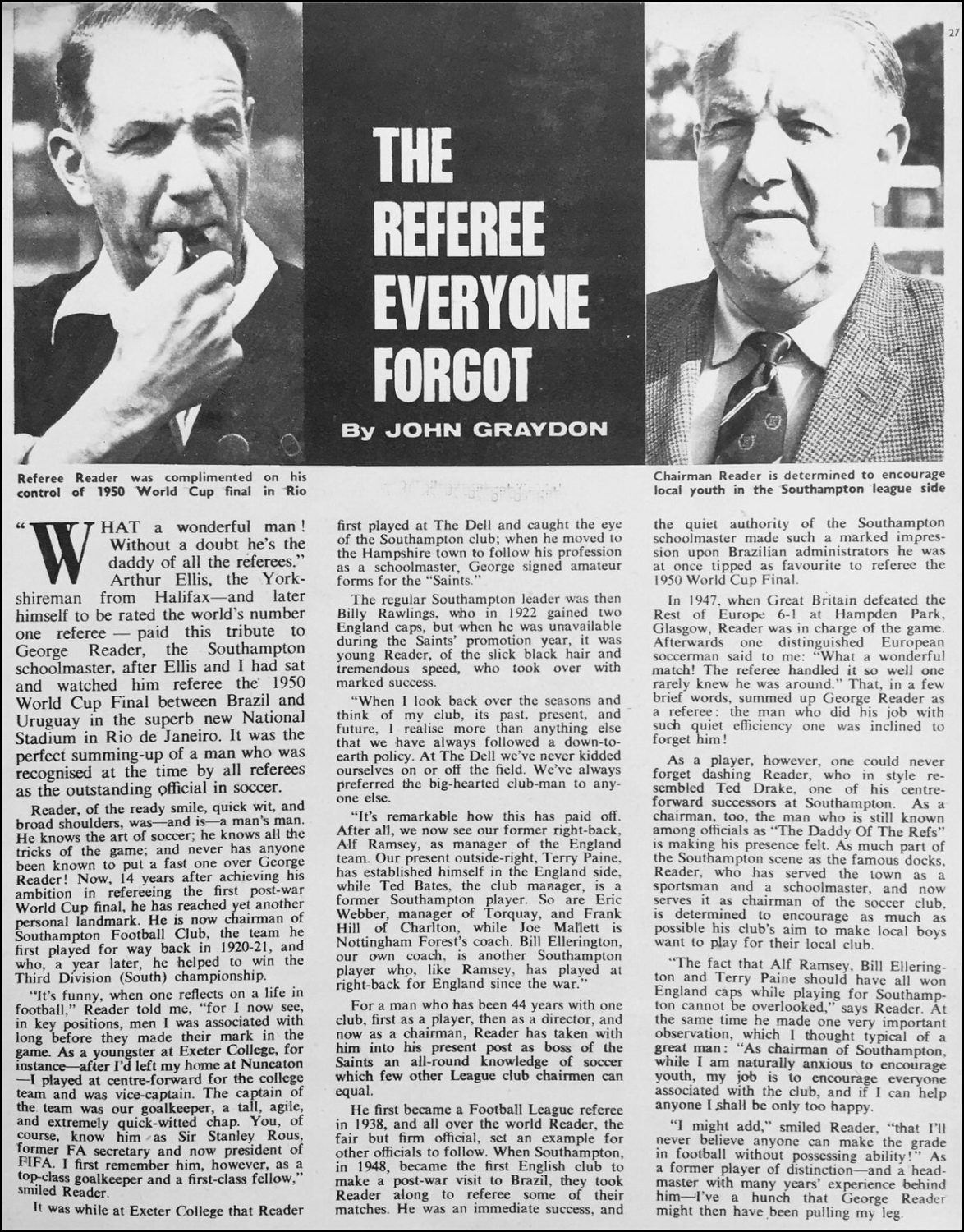
But the best was yet to come. In 1948, the Southampton director, Rex Stranger, who was master-minding the team’s tour of Brazil, suggested to the hosts that he take Reader along “to confer with referees in Brazil.” On arrival, however, George was invited to referee all of the Saints’ matches. To say that he was a success would be an under-statement. The press (see scrapbook section) could not get enough of his “masterclass in the use of the whistle,” a compliment closely followed by the thought that “George Reader won the match which Southampton lost.” And so on – to the extent that the British Ambassador, Sir Nevile Butler, felt that Reader had “had all the bouquets that it is good for one man to receive.”Stranger negotiated a contract for George to stay on, but he was by now in his third Headship, at Western School, and that was where he wanted to be.
He would, however, return to Brazil in 1950 – even though he was by now 53 – as one of the officials for the World Cup finals. Selected to referee the opening game, he also had charge of the last – not the Final, as there was no such thing in FIFA’s clumsy structure for the tournament, but the decider, as it turned out, between Brazil and Uruguay. However you label the match, it was the pinnacle of a refereeing career and George hung up his whistle upon returning home.


He became a Southampton director in 1952, progressing, shortly after his retirement from Western School, to the chairmanship in 1963. In his 14½ years in the chair, he oversaw the club’s progress to Division I under the famously patient Ted Bates and then appointed, as Bates’s successor in 1973, Lawrie McMenemy, a man in a hurry. The chairman would regularly offer his young manager a Latin motto: festina lente (“make haste slowly”). Notwithstanding, McMenemy rapidly rebuilt a side fit for a Cup-run. And so, on 1 May 1976, George Reader was proudly sitting next to the Queen, as Southampton upset the odds to beat Manchester United in the FA Cup Final. He had come a long way since that uncomfortable debut afternoon at Loftus Road.

- Nuneaton T 1914 - Aug 1919
- St Luke’s College (Exeter)
- Exeter C Aug 1919
- SOUTHAMPTON Sep 1920
- Harland & Wolff 1921
- Cowes 1922
- Southampton FA referee 1930
- FL list, linesman 1936, ref 1939
- international refs’ list 1943
- SOUTHAMPTON director 1952, vice-chair Oct 1961, chairman Nov 1963
| Competition | Apps | Goals |
|---|---|---|
| FOOTBALL LEAGUE | 3 | 0 |
| Total | 3 | 0 |