
3 Nov 1944
Govan, Glasgow
2661 Sub
1962 — 1972
4
Brought up as a “left-footer”, religion-wise, Denis Hollywood was a naturally right-footed footballer who spent nearly all of his professional career on the left. Born into a large Catholic family in Govan in 1944, Denis lived, until he was 15, with a family-relative by marriage, to whom he has always referred, for simplicity’s sake, as his grandmother.
He went to St Saviour’s School, just up the road from Broomloans, the Protestant school attended by Alex Ferguson, three years ahead of Denis. The rivalry between the two schools is discussed in Fergie’s memoirs, Denis points out. It was no surprise to hear him cite this source – accurately, of course – as the table in his sitting-room whenever he welcomes historians into his Locks Heath home is piled high with hardback autobiographies. Mainly of footballers, although Bill Clinton is among them. His grandmother lived bang-opposite Ibrox Stadium so, although his religion obliged Denis to be a Celtic supporter, who “loved Bobby Evans and Charlie Tully,” he was a regular at Ibrox, where boys of his age would “stand at the turnstile and ask somebody to lift you over.” That all ended when he was 11.
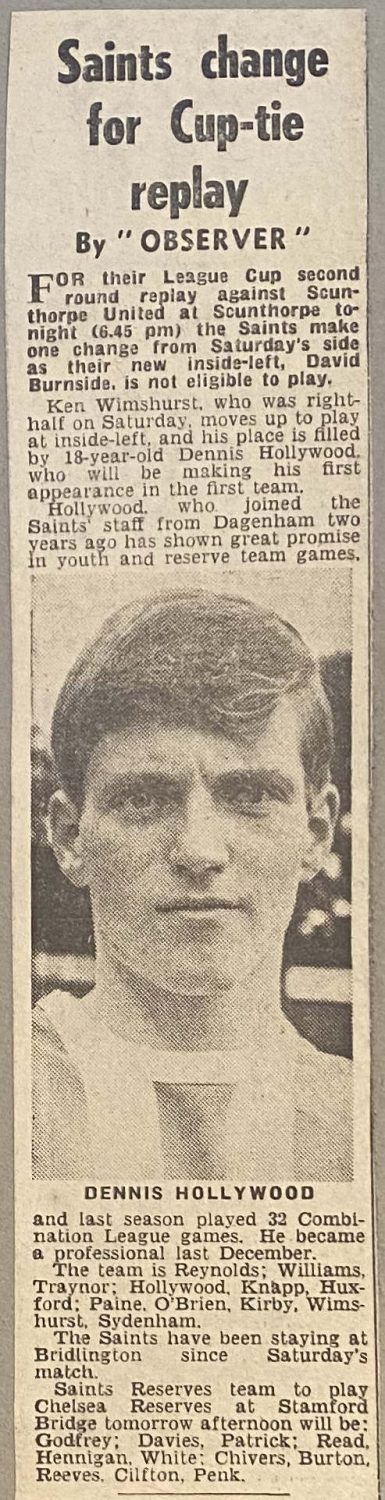
His grandmother moved to Essex, to be near one of her sons. Which explains why the teenage Hollywood was playing for Ilford Boys and then London Boys and having trials at West Ham and Tottenham. He was keen to be taken on by one of them, and so stay at home, but then Jimmy Thompson, Chelsea’s scout, came into his life. Renowned for plucking players from East London – most famously Jimmy Greaves and Terry Venables – Thompson tended to use what Venables describes as a “cloak-and-dagger” approach. He would sometimes moonlight for Southampton, treading, as the Saints’ then manager, Ted Bates, put it once, a “very thin line,” outside what might be considered “the rules”.
Southampton owed this dodgy dealing to their president, Herbert Blagrave, a race-horse owner for whom Thompson used to place bets. It all called for two forms of deception. First, Chelsea’s scout aimed to shield his manoeuvres from his paymasters’ gaze by giving the lads false names. Secondly, when prospects were as reluctant as Denis to leave London, Thompson would pretend that Hampshire was no distance away, at all. The train from Waterloo had barely cleared Clapham Junction, Denis reckons, before Thompson was reassuring his charges: “nearly there now, lads.”
Denis can’t recall any pseudonym Thompson gave him, but he was soon signing, under his own name, for Southampton. His grandmother was “absolutely devastated” when he got home with the news.
She soon had Denis back, though, when he fled Southampton, homesick. Bates hurried to Essex and persuaded her to let Denis return to The Dell. But because Denis didn’t like his digs, Bates found the perfect alternative: the unsettled teenager would move in with left-half Cliff Huxford and his wife.
Living with “the best professional in the club – he didn’t drink; he didn’t smoke; he went to bed early” – provided Denis with “a terrific grounding.”
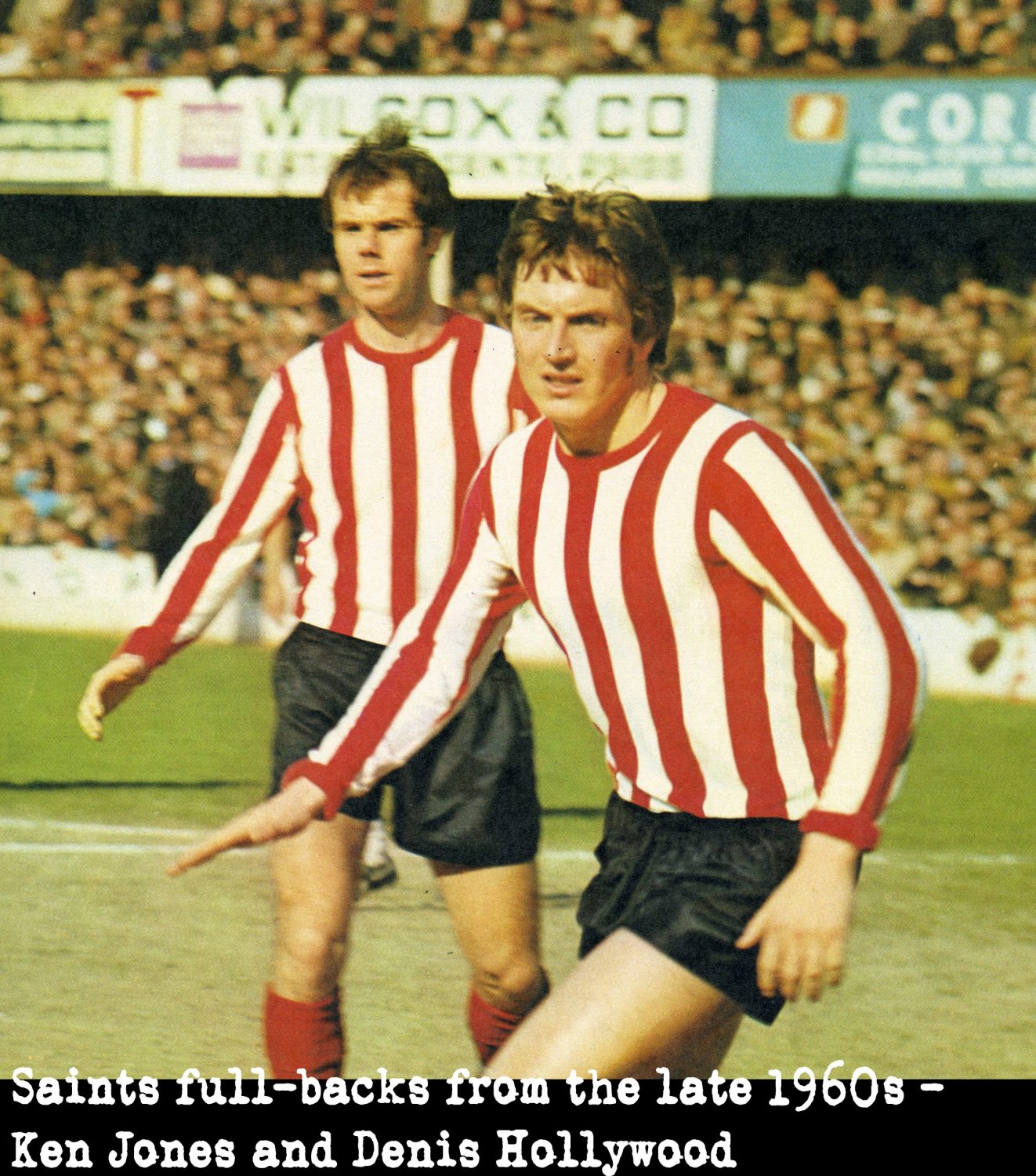
Until he got married at 19, that is. Getting your young players married off early may be every manager’s dream, but it meant Denis’s forfeiting the exceptional discipline of the Huxford household. That’s not to say that he took to drinking a lot – he never would – but he “did go out and socialise” too often. By now, he had made his first-team debut at right-half, but was about to convert to left-back, where Bates told him he would “have more chance” of establishing himself – as a successor to Tommy Traynor. He wasn’t exactly enamoured of Bates’s logic: in midfield, “you’re continually in the game,”
Denis reasons, but full-backs have to do “a terrible lot of running and not touching the ball.”
And nor was he expected to get forward the way he would be today: in the 1960s, “your main job was tackling and winning the ball.” It certainly “wasn’t attacking.” Maybe not. But Saints fans of a certain age will recall Denis’s first goal for the club, a vital equaliser as the Saints came back to win 3-2 at Plymouth in their 1966 run-in to promotion to the First Division. Denis might have reached the top flight a lot sooner, of course, had he made the grade at Tottenham or West Ham. Yet he never felt that joining Southampton held him back. He “didn’t think of Southampton as a small club.” No matter that they were newly promoted to Division Two when he joined them in 1960, he points out that Terry Paine and John Sydenham had each won Under-23 caps during the 1959-60 season, in which the Saints had won the Third Division championship.
Denis was capped by Scotland at U-23 level, in his turn, as he established himself as the Saints’ left-back in 1964-65. He would be in the squad a few more times, but would never make another international appearance – a disappointment exacerbated by having to share a room with Billy Bremner, which meant listening to him banging on about Leeds. So why didn’t he push on? While he admits to a “lack of self-discipline,” he blames the fact that he began to put on weight during the 1965-66 season. He attributes this weight-gain to cortisone injections for the injury that kept him out for much of that season. Ever the keen reader, Denis looked up the pertinent “medical stuff” to reassure him of that causal link. But Don Taylor, who arrived as the physio in December 1971, reasons that any association between those injections and an increased weight was more likely to be coincidental than causal. Quite simply, some players are more prone than others to put on weight. Before the dieticians arrived in force, the remedies were limited.
Which is why Denis spent so many – not terribly beneficial – hours in the sauna. Even with the injections, his knee would be so swollen after a game that he’d be unable to train for half-a-week, inevitably adding to his weight problem. Notwithstanding, he enjoyed his introduction to top-flight football, coping with the increased speed and even getting among the goals – three of them in 1966-67, all with his right foot.
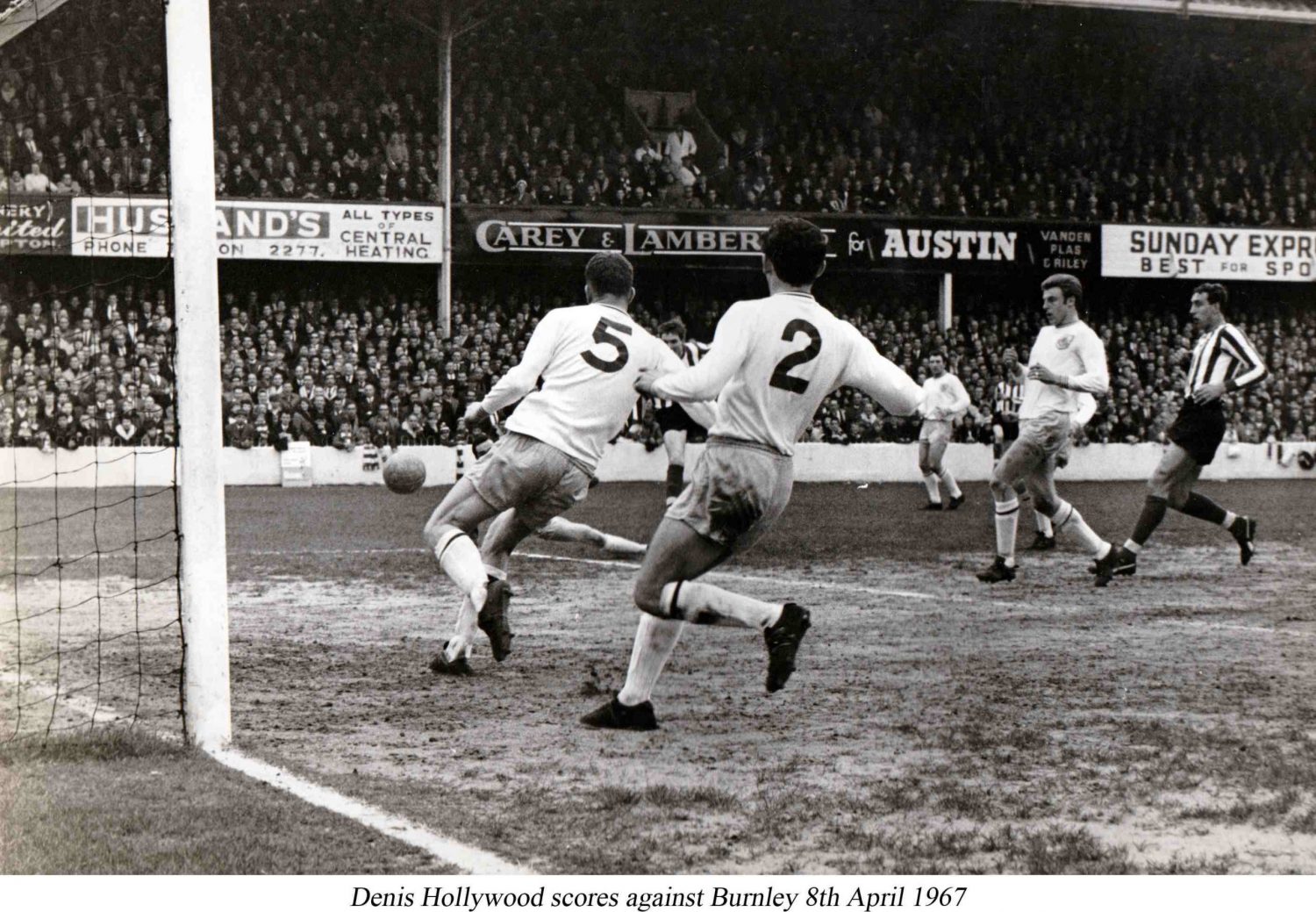
That was the end of his goal-scoring, although he did become something of a TV-celebrity for a penalty he missed at Anfield in October 1969.
Paine had failed with an early-season penalty and Ron Davies, the last Southampton player to succeed from the spot, way back in April, was not in the side at Liverpool. At the last minute, Bates asked for a volunteer. Denis spoke up and, no matter that his manager gave him “a strange look,” the job was his. Liverpool had just taken a 3-1 lead in the 85th minute when Mick Channon was felled. Denis stepped up to the spot and “blasted it”. Goalkeeper Tommy Lawrence trapped the ball with his legs in a manner that so appealed to the producers of BBC’s Saturday lunch-time Grandstand that the save would be part of the opening credits, the next season.
Which is why the Southampton players would hurry their pre-match lunch, before seeking out a TV. “Let’s go and see Den’s penalty” became that season’s running joke.
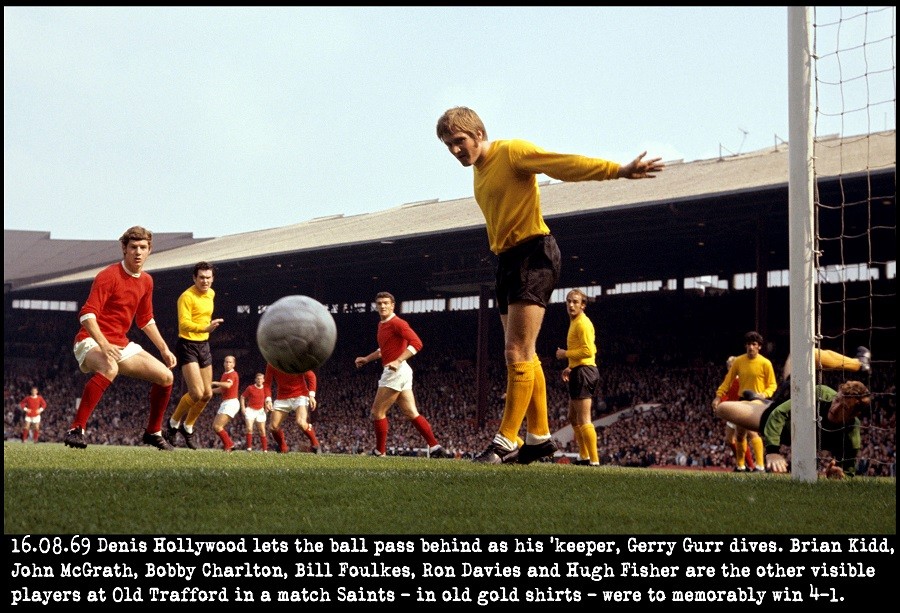
Denis survived the banter – and, indeed, his weight-gain – to the extent that he missed fewer games in 1970-71 than in any other season. So more’s the pity that 1971-72 would prove so anti-climactic. He would play mainly Reserves-football until mid-March, which at least meant missing the ignominy of an 8-0 defeat at Everton in November and the BBC’s much-repeated horror-show, the 7-0 hammering at Leeds in early March. His replacement, Roger Fry, took the can for the latter debacle and his Southampton career was over.
Denis returned for the run-in and an escape from relegation. But then the manager dropped a close-season bombshell. He was releasing Denis on a free-transfer, with the advice that, “if you’re sensible, you’ll make yourself quite a bit of money.” Denis ruefully reflects that, “obviously, I wasn’t sensible, because I didn’t make any.” He had chances to do so, turning down a move to the States before having serious negotiations with a delegation from South Africa. His wife, Irene, and he were free spirits, yet to start a family, and she would have “loved it” in South Africa, Denis reckons. But he dithered, lost the chance and ended up joining Second Division Blackpool, for a probationary period.
Denis has lived to regret this “bad move: it was the worst thing I could do.” He would spend the week in a guest-house, returning to Hampshire at weekends. His Saturdays would remain free of first-team football. On the fourth or fifth Sunday evening of this routine, he was on Southampton Central Station, waiting for the train to Waterloo, when he thought “Nah! I’m not going back.” And he never did. He “didn’t even have the decency,” he confesses, to let Blackpool know. So, at 27, Denis Hollywood left League football, a one-club man. It might have been a whole lot better than that, had it not been for… what? The weight-gain? Indiscipline? Or maybe, as he puts it, there was just “something lacking in me.” Whatever Denis may have lacked, Terry Paine liked what he offered. When selecting, in his 2008 biography, a Saints XI from his former team-mates,
Paine picked Denis for “his tenacity, … his will to win” and “the fact that he hated losing.” What’s more, “he could certainly mix it with the best of them.”
His mixing it with Mick Summerbee was legendary, yet exaggerated – not least by Summerbee, who states categorically, in his autobiography, that Denis “must have been sent off five or six times playing against me. I got sent off a couple of times against him as well, as a consequence.” This is utter nonsense as the fact is that Summerbee was once dismissed at The Dell, but his contretemps, on that occasion, was with David Walker.
Denis, on the other hand, was never sent off in his first-team career.
He was “so humiliated” by his sending-off as a teenager, for fighting in a Reserves match at Swindon, that he vowed not to let it happen again.He picked up enough bookings, though, to serve a suspension or two. He always tackled with his natural right foot, which was bound to create the occasional problem when chasing a winger down the line. Yet Denis declines to make this an excuse for the “mistimed tackles” to which he attributes most of his bookings. He swears he “never spoke back to the referee or anything like that.” Summerbee is having none of this.
Denis was, he reckons, a “crème de la crème lunatic.”
In a similar vein, Harry Redknapp, another outside-right of that era, put it to the Southern Daily Echo in 2004, that
Denis was “an absolute nutter”, who would “whack you after the ball has gone.”
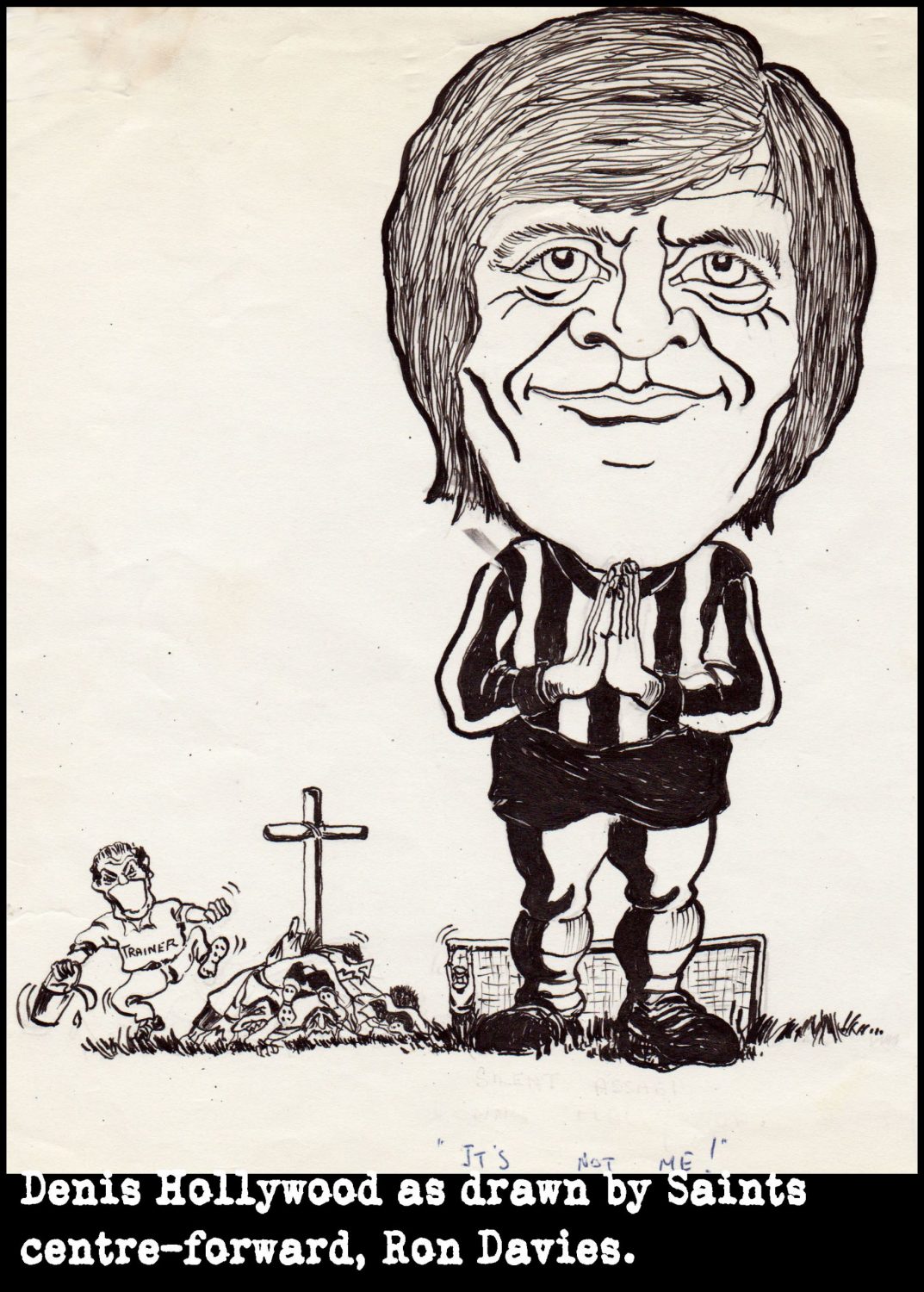
Denis disputes that he was wont to leave his foot in, but that doesn’t stop him having a laugh at his own expense with a pertinent story about Redknapp. When Harry was managing West Ham, Denis had occasion to ring him. Frank Lampard Sr, who took the call, told Denis that he’d alert Harry, who was in the shower. He returned with a message: “Arry’s on his way. He said to tell you he’s just putting his pads on.”
Denis did play a bit of non-League football turning out for David Burnside’s Bath City and Cliff Huxford’s Basingstoke. He initially worked in the Docks. Then, after service with Union Castleand Solent Containers, he moved to the Oil Refinery at Fawley, as a materials-controller. His last job, before retirement, was at the Air Traffic Control Centre at Swanwick.
- Glasgow Schs
- Ilford Schs
- Tottenham H trial
- West Ham Utd trial
- SOUTHAMPTON app Oct 1960, pro Dec 1961
- Blackpool Jul 1972
- Bath C Oct 1972
- Basingstoke T Jan 1973
| Competition | Apps | Sub | Goals |
|---|---|---|---|
| FOOTBALL LEAGUE | 234 | 0 | 4 |
| FA CUP | 15 | 0 | 0 |
| LEAGUE CUP | 13 | 0 | 0 |
| EUROPE | 4 | 1 | 0 |
| Total | 266 | 1 | 4 |